

A summer in the desert helped two students reach new heights, both on mountain trails and in their career paths. Our first internship at Trout Creek Ranch provided educational opportunities through field work and community projects that benefitted all involved.
Spring and summer are busy seasons at the ranch and throughout the Fields basin. Plants are in bloom, and birds and mammals are on the move. Cattle graze in the uplands while the valleys are hayed. Neighbors, partners and volunteers work together on multiple projects and use the headquarters daily.
We sought interns to assist in facilities, land management and communications for the first time this summer. A focus for conservation planning was on stream restoration, species monitoring, data input and infrastructure maintenance. Hosting groups and connecting with neighbors were part of community outreach.
For Trout Creek Ranch Restoration Manager Brooke Gray, the main goal of the program was to open up a whole new world for people in conservation and the ranching community alike. Explaining her job can be difficult, but she feels that’s a good thing.
“I live in the most amazing place and work with the most amazing people, but it’s also really hard, not just because of the remoteness (and that’s hard!), but because of the burden of the decisions I make every day that will inevitably have lasting effects,” expressed Gray.
This starts with the tree she decides to plant that will provide shade in 20 to 100 years, or the invasive species she deems important to control, what fence to remove, what building to construct and what stream mile to restore. “It’s a lot, but it’s worth it, and I wanted interns to experience it all in the most profound way — up close and personal.”
Financial assistance from the estate of Brien Stafford and the Roundhouse Foundation allowed ODLT to hire two paid interns to live and work at headquarters for the summer. Stafford family representative, Nan Noble, was excited to turn this concept into reality.
We were thankful for the generous support and impressed by the applicants. Lauren MacLean was a junior at the University of Illinois Urbana-Champaign studying ecosystem stewardship and restoration ecology. She wanted to develop and refine practical and professional skills needed for natural resource positions. Her summer internship opportunities were between a position an hour from her home, or at Trout Creek Ranch, 30 hours and nearly 2,000 miles away. She felt it was impossible to pass up the opportunity to learn about a new place and lifestyle.
“It was kind of a no-brainer. I had to make myself do it because it was scary,” recalled MacLean. “I had no idea what it was going to be like, but it was a great decision for me. It was worth it.”
Erin Arney of Pleasant Hill, Oregon was working towards her Associate of Science at Linn-Benton Community College and found the variety in the internship very appealing. She has family connections in the area and had visited prior, but hadn’t lived so far away from home.
“That place makes you closer to nature in a good way, and even though you’re in a small rural area, community is definitely a big thing there. All the people try to help each other out and be very supportive of what everyone else is doing. I think that’s really cool.”
This was a common theme of the internship with a mixture of projects. In summers prior, MacLean had led groups as a camp counselor and interned at an arboretum sampling soils and identifying plants. She was eager to learn about western species and discovered how native silver buffalo berry is being outcompeted by the introduction of Russian olive, especially in wet areas on the ranch. MacLean, Arney and Gray all took on the rough task of surveying these thorny shrubs and small trees across 3,000 acres.
“Getting to the areas was almost impossible sometimes,” winced MacLean. “It was so dense in there with the willows. You’re walking through Canada thistle and spikey things and it hurts.”
“I’ve never surveyed a piece of land like this in my life,” recalled Gray, who was a caretaker of a preserve for a decade beforehand. “The wet meadows are always surprising to me. You think you can walk out there easily, but just getting to some spots felt like a fight for your life. We’re still scarred, literally,” she laughed. “I was also astounded by how much native buffalo berry was out there.”
This important field work will guide long-term management of both species and was one of many projects team members were excited to begin. It was also helpful to have assistance with ongoing stewardship and partner programs.
Team members from ODLT, The Nature Conservancy, Oregon Department of Fish and Wildlife and Harney Soil and Water Conservation District held field assessments to restore springs in the Pueblo and Trout Creek Mountains. Arney was wowed by the complexity involved in deciding the best course of action to assist stream flows. “The springs project was definitely a big one,” she reflected. “It wasn’t something I was really knowledgeable about, and I really enjoyed it and learned a lot.”
Arney was similarly surprised while leading her first volunteer group at dawn for bird counts in the wet meadows. Other highlights included land inspections and offering input on how to improve corral systems.
The variety also intrigued Lauren from the start and stuck with her until the end. “I want to do what Brooke does. I want to be in a position where I can put my hands in everything,” declared MacLean. “It’s hard to find those sorts of positions.”
She recalled learning how to use a riding lawn mower, pour concrete, and manage lodging logistics, while also monitoring properties, assessing and providing input on restoration proposals, assisting volunteer projects and learning from local Tribal members, among other meaningful experiences.
“This summer’s been great. I feel like I’ve done so many different things in many realms. From the nature side, facility and neighbor-relations side, I feel like I’ve tapped into everything. I’m feeling really good,” beamed MacLean.
Both interns felt the program was invaluable for their careers and future decision-making. They shared that some things couldn’t be put into words, but it was clear that their adaptability and confidence levels soared.
“It was a very good experience and was a lot of fun,” shared Arney. “I really liked how everything was followed through with a plan and everyone was so willing to help. I learned a lot of things that I’ll take in my professional career and my personal life.”
MacLean returned to Chicago to major in natural resources and environmental sciences, while Arney ventured to Arkansas and switched from studying education to animal science. Though they’ll both do different things, they have a similar feel for the land and the community.
Arney echoed the sentiment. “It seems like everyone around there has a pretty good outlook on ODLT, even people who have lived there for a very long time. I’m sure it can at first be negative or scary when a new group comes in, but it seems everyone has a very good perspective of what ODLT is doing, so that’s really good and very important.”
We’re so grateful for the passion, dedication and humor that Erin MacLean and Lauren Arney brought with them each day. Though their time was temporary, the experience will remain with them for years to come, as will the impact of their work. “This summer was wildly successful and the interns far exceeded my expectations,” reminisced Gray. “We laughed a lot and grit our teeth through some very challenging days and they never complained. I already miss having them around.”
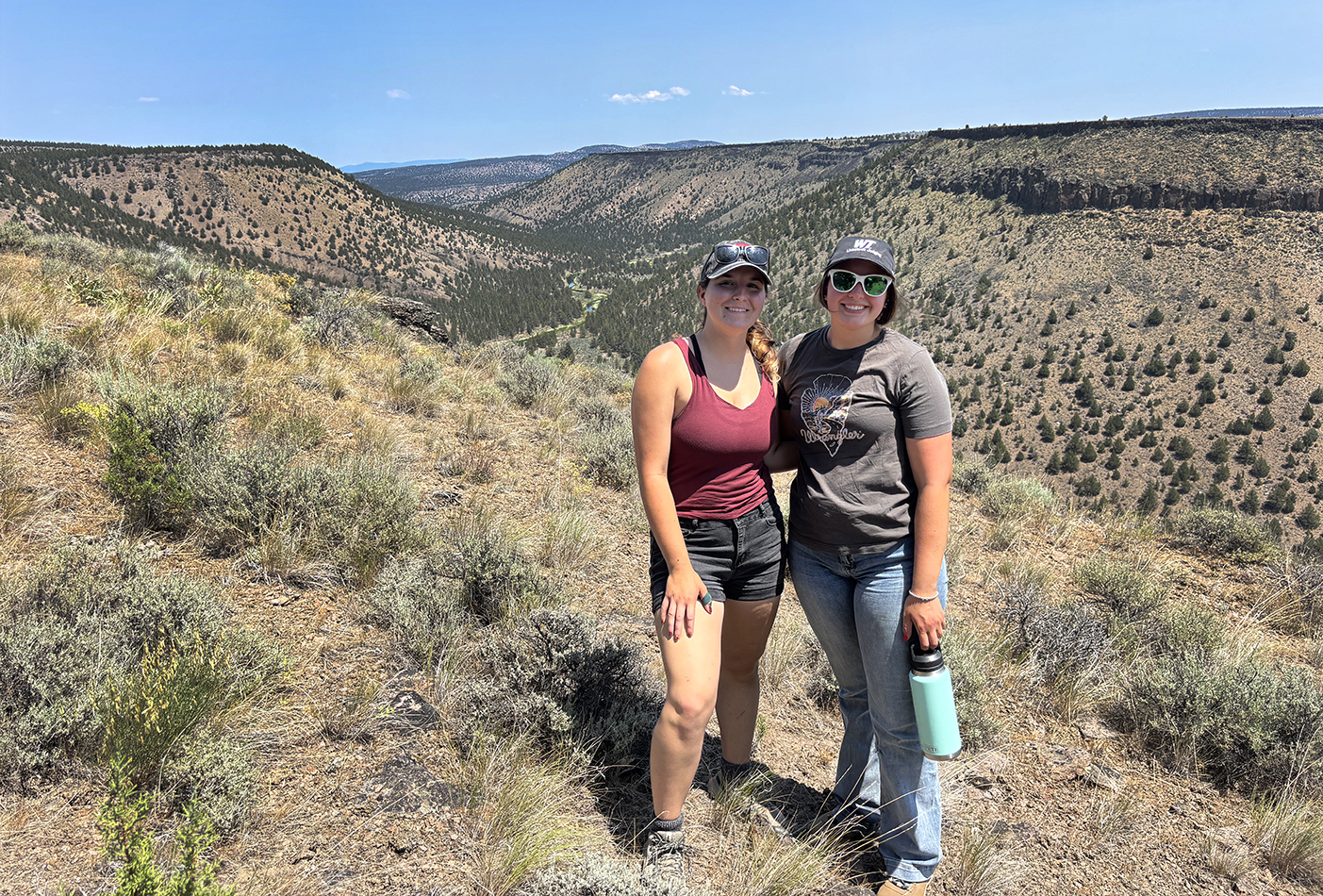
Feature image: ODLT Interns Lauren MacLean, left, and Erin Arney thoroughly enjoyed land inspections over the summer.
Published September, 2025
Learn More
- Dive into the 2022 research of graduate students that helped prioritize conservation plans at Trout Creek Ranch.
- Read about the range of changes that occurred at headquarters since 2021.
- Take part in similar volunteer projects through land inspections, bird surveys and work parties.
Stay Tuned!
- We’ll keep you posted on updates and opportunities at Trout Creek Ranch and Disaster Peak Ranch in our monthly online newsletters and on our volunteer page.
Discover details of the highlighted regions
View Wildlife Camera Videos
More perspectives
Related Reads
Desert Duet
A conversation with SageCon Coordinator Rachael Davee & Oregon Department of Fish & Wildlife Biologist Andrew Walch — Redmond, OR
Be the Mountain
A conversation with Jenner & Harland Yriarte — Steens Mountain High Altitude Running Camp Organizers — Frenchglen, OR
A Range of Change
Trout Creek Ranch updates help conservation and community.
Grouse Count
We've joined in state surveys of greater sage-grouse.
Reaching for new heights in conservation
Together, we can conserve Disaster Peak Ranch!
Going with the flow
We're restoring a creek to help fish and wildlife.
A land of learning
Local Tribal members shared stewardship practices to inspire youth.
Looking out for the birds
Volunteers help guide restoration plans with wetland bird surveys.
Watching wildlife
Wildlife cameras help with conservation plans for animals throughout the year.
Virtual fences mooove cows online
Virtual fence is a new technology that can help land managers maintain wildlife connectivity in permitted grazing areas.
Tribal Gatherings
Tribal leaders discussed the Native history and stewardship of their homelands at Trout Creek Ranch.
Research fueled by fire
Oregon State University finished 10 years of fieldwork on sage-grouse responses to wildfire.
Tribal Stewards
Tribal teens lead on conservation efforts through Northwest Youth Corps.
Spring returns
Rod Klus returns to researching sage-grouse for Oregon Department of Fish and Wildlife.
Mountains of Research
Researchers spent a summer in the mountains and left with more than data.
Spreading wings in conservation
Jack Strang created new connections to the high desert during our first internship.
Neighbors helping neighbors fight fires
Rangeland Fire Protection Associations protect the high desert and each other.
Watching for wildfires
A live camera on Beatys Butte helps wildfire efforts in the high desert.
Spring into recreation & conservation
John Sterling works at the intersection of both as a volunteer board member.
Balancing a range of concerns
Angela Sitz brings wild and working lands together.
Wildlife encounters
Land Trust volunteers are keeping track of animals on the ground and on camera.
Keeping it connected
Closing the unnatural gap between wildlife refuges opens doors for pronghorn.
Seeing the land in a different Light
Northern Paiute Tribal member Wilson Wewa brings a Native perspective to ODLT's work.
