

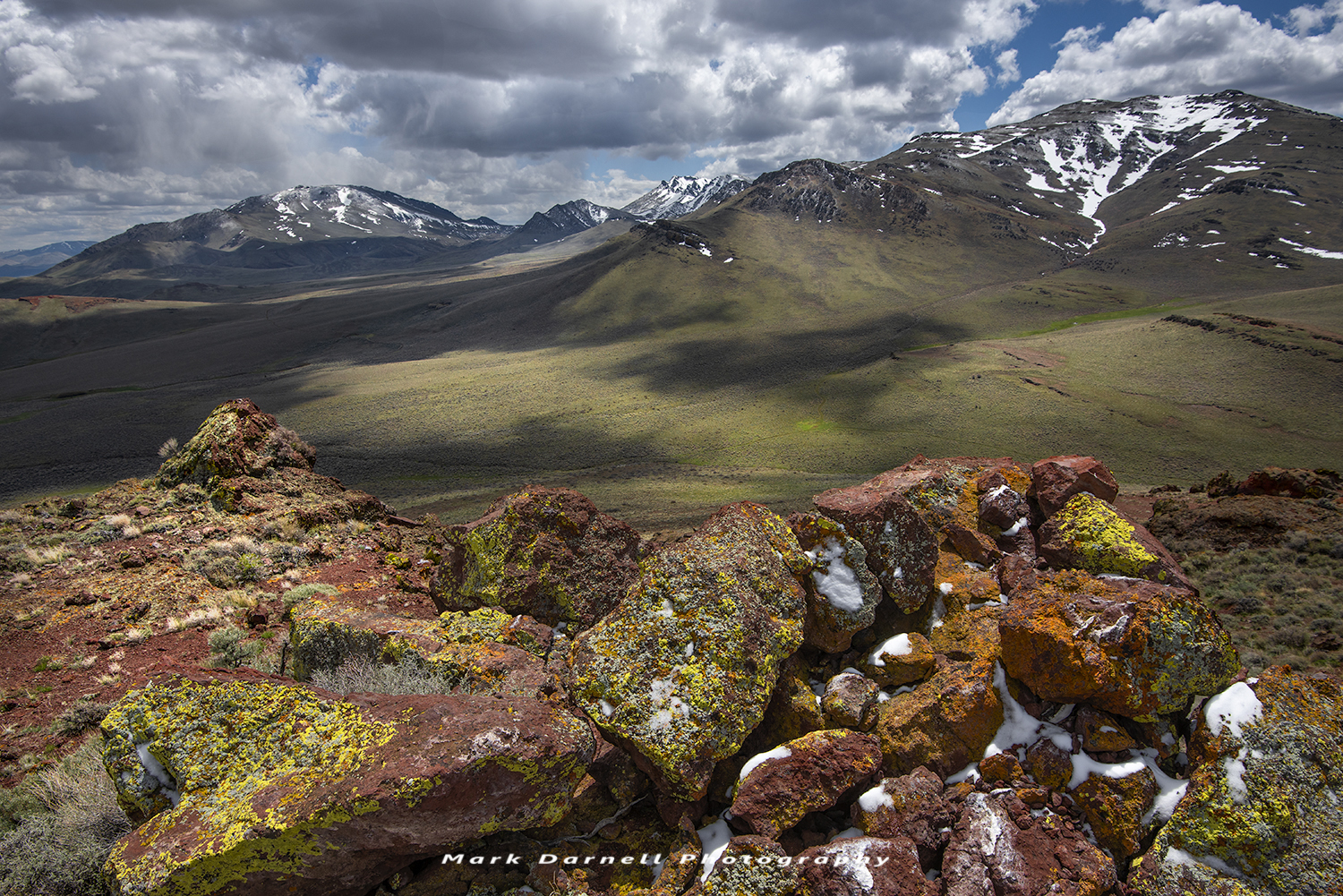
New heights for conservation
This dramatic conservation area ranges in elevation from 4,005’ in the Alvord Desert to 8,634’ at the summit of Pueblo Mountain, the second-highest peak in southeastern Oregon. It provides climate-resilient habitat connectivity between more than one million acres of public and private land in one of the state’s last great open spaces.
The project includes 334,000 acres of wilderness study areas and ensures connectivity between 170,166 acres of designated wilderness and 572,896 acres of national wildlife refuges. Steens Mountain Wilderness is to the north, Hart Mountain National Antelope Refuge is to the west, and Sheldon National Wildlife Refuge is along Oregon’s southern border. Limiting fragmentation, restoring sensitive habitats, and facilitating innovative public land management are critical to maintaining this resiliency and connectivity.
A series of valleys, basins and meadows lie in the erosional valley between the two ridges of this tilted fault block mountain range. These lands are home to a wide variety of plant and animal species native to the Great Basin—some threatened, some endangered, some unique to this region. California bighorn sheep and greater sage-grouse are among the many species that will benefit from our effort to conserve and restore these high-elevation inholdings. This project area as a whole encompasses nearly 20% of Oregon’s sage-grouse population and is recognized as one of the most important areas for sage-grouse conservation in the US.
As important as this area is for wildlife today, it will become even more vital as our climate changes. Approximately 85% of the project area is part of The Nature Conservancy’s national Resilient and Connected Landscapes. This means these lands have both complex topography and connected land cover relative to other important habitats in the Columbia Plateau and can rebound and sustain themselves.
Rather than trying to protect biological diversity one species at a time, conserving a range of physical environments will protect a diversity of plants and animals under both current and future climates. The Nature Conservancy’s assessment of the area points out that our proposed actions of restoring sensitive habitats and facilitating innovative public land management are critical to maintaining this resiliency and connectivity.
Some of the project’s conservation parcels are scattered among public lands and the designated Wilderness Study Areas (WSAs), including Pueblo Mountains WSA. These lands are places that have wilderness characteristics – size, naturalness, and outstanding opportunities for solitude or primitive recreation. They allow for non-motorized access/recreation and are open to public hunting and fishing per state regulations.
Desert Duet
A conversation with SageCon Coordinator Rachael Davee & Oregon Department of Fish & Wildlife Biologist Andrew Walch — Redmond, OR
Be the Mountain
A conversation with Jenner & Harland Yriarte — Steens Mountain High Altitude Running Camp Organizers — Frenchglen, OR
A Summer to Remember
College interns were a huge help over the summer.
A Range of Change
Trout Creek Ranch updates help conservation and community.
Grouse Count
We've joined in state surveys of greater sage-grouse.
Reaching for new heights in conservation
Together, we can conserve Disaster Peak Ranch!
Going with the flow
We're restoring a creek to help fish and wildlife.
A land of learning
Local Tribal members shared stewardship practices to inspire youth.
Looking out for the birds
Volunteers help guide restoration plans with wetland bird surveys.
Virtual fences mooove cows online
Virtual fence is a new technology that can help land managers maintain wildlife connectivity in permitted grazing areas.
Tribal Gatherings
Tribal leaders discussed the Native history and stewardship of their homelands at Trout Creek Ranch.
Research fueled by fire
Oregon State University finished 10 years of fieldwork on sage-grouse responses to wildfire.
