

Skip to content Skip to footer

Grouse Count

Male sage-grouse count on extravagant dances to woo females as surveyors tally them. In spring, our small teams recorded birds in courtship near the border for state records.

As in a play, the curtain rises with the sun and male greater sage grouse take their places. Their stage is in Oregon’s high desert and this performance is one of survival, with females judging each one to secure a brood. Spotted tail feathers fan out and point toward the sun as males strut across patches of the sagebrush sea, vying to be the center of attention for a partner. Their white chests are held high, carrying bulbous yellow air sacs that they drop low and shake back upward. The move creates a high and low pop as their wings stretch backward and their tails mimic starbursts just after dark. The signature sound can carry for miles as a drumbeat in the distance. It attracts females who lie in wait in the sagebrush, coming closer to gauge a worthy mate from his dawn dance.

"The whole thing is just one of those curiosities of nature that you never get to see."
Brent McGregor
ODLT Volunteer, Photographer
Greater sage-grouse males perform courtship displays in the morning light of the Pueblo Mountains. — Brent McGregor

Brent McGregor lives in Andrews and considers himself more than lucky to have participated in a couple surveys that assist with documenting these sensitive species. And he’s not the only one watching, because the survival of the species teeters on the performance of this delicate dance. 

The greater sage-grouse is an indicator of the health of the broader sagebrush steppe ecosystem and nearly 400 species living there, but this umbrella species is losing its habitat. Threats loom from wildfires, invasive annual grasses, urban and industrial development, conifer expansion and predation. In 2015, the U.S. Fish and Wildlife Service did not list the greater sage-grouse as endangered, deeming it “warranted, but precluded” since it was still numerous across its range, and in light of ongoing conservation efforts. A decade later, the Oregon Department of Fish and Wildlife (ODFW) continues to lead greater sage-grouse population monitoring in Oregon. Their efforts include spring lek surveys, summer brood routes, and hunter harvested wing analysis. Thankfully, each spring, males gather on breeding grounds (called leks) and return year after year. This reliable behavior helps researchers count males to measure population estimates and trends

From mid March through April, more than 100 staff members from ODFW, partner agencies, and volunteers spend upwards of 750 mornings surveying at least 700 leks. Retired ODFW biologist Rod Klus covers areas in the Trout Creek and Pueblo Mountains and has stayed at Trout Creek Ranch to survey nearly 30 leks on surrounding lands. This area encompasses nearly 20% of Oregon’s sage-grouse population and is recognized as one of the most important areas for their conservation in the United States. In 2024 and 2025, ODLT started contributing in nearby counts with a handful of people. The daybreak dance is only done for a short time, in a certain place tucked high in the mountains, and males will leave if they feel threatened, so lek locations are kept confidential. 

Greater sage-grouse males compete for partners in their courtship dances. —Raj Ramamoorthy

“Very few people know about the mating event. Even folks that live near sage-grouse can go their whole lives without witnessing the early morning mating ritual. To unknowingly be at a lek site at the right time on the right day isn’t likely,” mused McGregor. “It’s such a rare thing to see that those who do are lucky.”

The Henricks are some of those people. Ty and Hollie live nearby in their family homestead and can view the Trout Creek Mountains from parts of their backyard. They’ve seen the birds on horseback, but not like this. As a rancher, Ty recalled waking early in the morning hundreds of times, but never to go see a bird. This sunrise spectacle was memorable for both of them, especially Hollie, who listens and watches for birds throughout the day. The mating dance was on her bucket list and something she’ll always treasure.  

"I’ll remember it for the rest of my life, for sure. It was amazing. I can hardly believe that I haven’t seen it before or been somewhere it was happening. It’s pretty magnificent."
Hollie Henricks
ODLT Volunteer, Landowner
From left, sage-grouse surveyors Hollie and Ty Henricks view a lek as Brent McGregor takes photos. — Brandon Palmer

ODLT teams counted eight leks in 2024, and six in 2025, with one being newly discovered through ODFW’s aerial surveys. Numbers varied, but the highest count at one lek was 51 males. Survey sites varied in elevation from 4,900’ up to about 6,200’ throughout the Pueblo and Trout Creek Mountains. Monitoring these mountainous sites entails coordinated trips with minimal people, and much driving and hiking in the dark to observe courting displays from a safe and unobtrusive distance. They sometimes amount to seeing tiny white specs bouncing in the distance, with rare instances when a pair will fly closer to have their own personal performance. 

The birds aren’t the only things on display at this hour. There’s also a light show (and sometimes light snow). At some counts, pink hues spread across snowy mountaintops, lighting the sage-grouse stage. Purples were seen high in the Pueblos, and even though an early morning breeze made it painful to dial in binoculars, it was worth the challenges. ODLT Outreach Coordinator Kharli Rose recalls being frozen in place, both from the cold and the awe. It was one of her most special birding moments of 20 years, especially since she learned about these western wonders in Florida while dreaming of mountains.

"To see sage-grouse through the morning mist, mixed in with pronghorn, made for such an iconic mountainous moment that my heart melted. I nearly had to pinch myself from being able to see them and help them.”
Kharli Rose
ODLT Outreach Coordinator
A sea of sagebrush spans across the Trout Creek Mountains at sunrise, but only select areas can set the stage for the intricate spring dance of greater sage-grouse. — Kharli Rose

ODLT Regional Stewardship Lead Brandon Palmer coordinated the surveys for ODLT and is also warmed by sightings of pronghorn antelope and mule deer interacting closely with the birds, who seem completely unfazed by them. These counts are his favorite type of field work and perfect for this early bird.

“The sagebrush steppe really comes alive in the early morning, with the calls of many different birds, yapping coyotes, and some of the first signs of spring green-up after a long winter,” Palmer shared. His enjoyment comes from “spending time in the remote high desert country that most people don’t get an opportunity to see.”

Wildflowers bloom amongst the frost in the Trout Creek Mountains. — Brandon Palmer
"I relish every chance I get at solitude, silence, and contemplation and often find those opportunities hearing the birds calling, the mist from my breath on these cold, brisk mornings, vibrant wildflowers emerging, and the sight of the sun cresting over a snow-capped mountain while there’s no other people around. It’s quite peaceful and is a tremendous blessing for me”
Brandon Palmer
ODLT Regional Stewardship Lead

It’s also heartwarming to know that greater sage-grouse numbers have increased in recent years, along with precipitation levels. There’s been an uptick in attendance at leks and of juvenile to adult ratios via the wing deposit analysis from hunters and summer brood routes. For surveys in the Burns District, 2024 numbers were up 66.5% from 2023, and it was the fifth year of population increase following three consecutive years of population decline (2017–19). Another trend shows the birds spreading out and establishing new leks across the landscape. Oregon’s oldest active lek has been monitored since 1941, and there’s hope these others may last as long, or continue to multiply.

A greater sage-grouse presents his plumage to attract a mate in spring. — Brandon Palmer

After their dance is done and as young males prepare to take the stage, we’ll be able to read a review of their performance, or at least the attendance. ODFW will issue a yearly report in fall on greater sage-grouse populations that includes birds in the Trout Creek and Pueblo Mountains. It will help with conservation plans throughout the state, along with ours for Trout Creek Ranch. This is all thanks to the time and passion of researchers and volunteers. Though reports won’t capture the full scenes or sentiments shared by surveyors, their early morning memories will be part of the sage-grouse story for seasons to come.

While their coloration helps them blend into brush throughout the year, the spotted and fanned feathers of greater sage-grouse males are on full display during spring courtship. — Brent McGregor

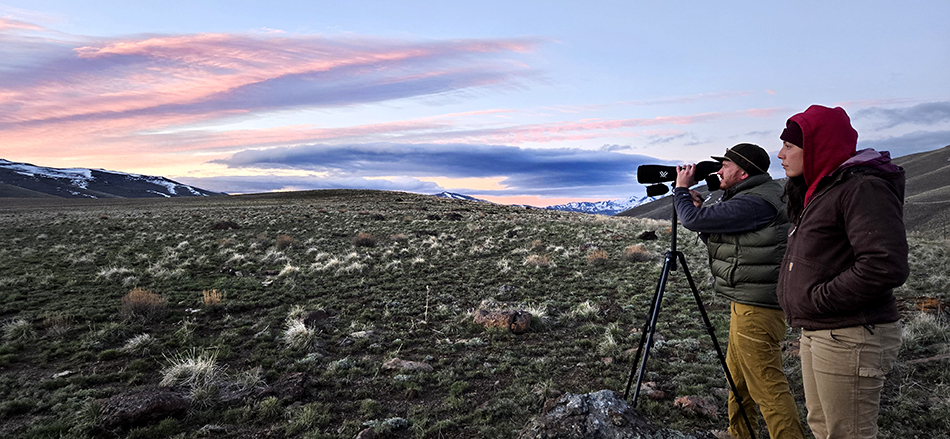
Feature image: ODLT Stewardship Lead Brandon Palmer and biologist Anna Hosford scan for greater sage-grouse in the Trout Creek Mountains at dawn. — Kharli Rose

Published June, 2025

Learn More

Stay Tuned!

Discover details of the highlighted regions


View Wildlife Camera Videos

More perspectives


Related Reads

Desert Duet

A conversation with SageCon Coordinator Rachael Davee & Oregon Department of Fish & Wildlife Biologist Andrew Walch — Redmond, OR

Be the Mountain

A conversation with Jenner & Harland Yriarte — Steens Mountain High Altitude Running Camp Organizers — Frenchglen, OR

Grouse Count

We've joined in state surveys of greater sage-grouse.

Watching wildlife

Wildlife cameras help with conservation plans for animals throughout the year.

Tribal Gatherings

Tribal leaders discussed the Native history and stewardship of their homelands at Trout Creek Ranch.

Research fueled by fire

Oregon State University finished 10 years of fieldwork on sage-grouse responses to wildfire.

Tribal Stewards

Tribal teens lead on conservation efforts through Northwest Youth Corps.

Spring returns

Rod Klus returns to researching sage-grouse for Oregon Department of Fish and Wildlife.

Wildlife encounters

Land Trust volunteers are keeping track of animals on the ground and on camera.

Keeping it connected

Closing the unnatural gap between wildlife refuges opens doors for pronghorn.