

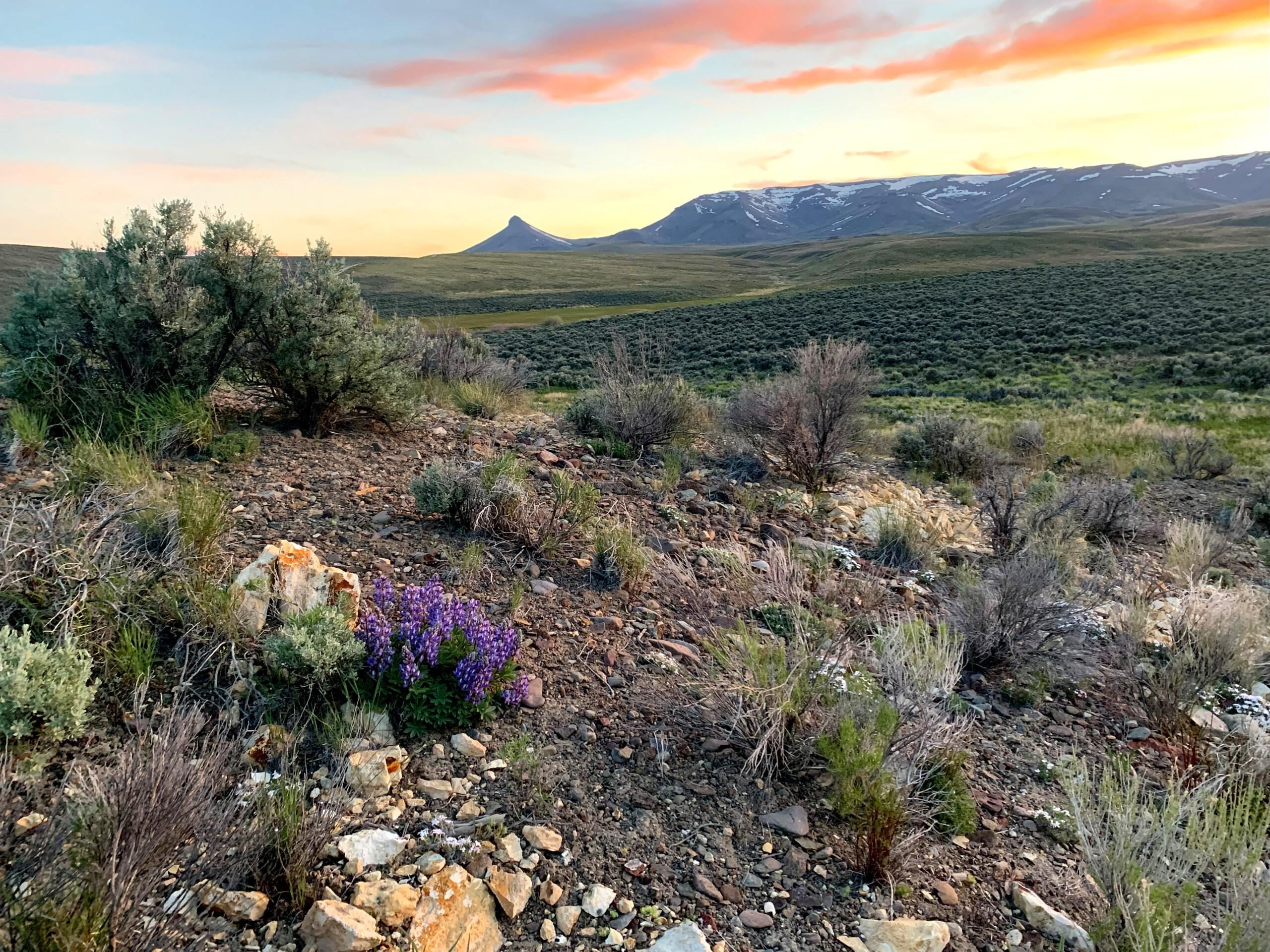
Landscape-scale Conservation
In 2025, the Oregon Desert Land Trust (ODLT) partnered with Western Rivers Conservancy to acquire Disaster Peak Ranch, a 2,690-acre property that includes livestock grazing permits on more than 55,000 acres of surrounding public lands in remote Southeastern Oregon. This acquisition builds on our 16,685-acre Trout Creek Ranch and Pueblo Mountains Conservation Project—one of the largest conservation projects in Oregon.
— Sage Brown
Located in Malheur County, Oregon, Disaster Peak Ranch is home to springs, wet meadows, and streams that disproportionately influence wildlife connectivity on this arid landscape. With grazing permits covering 56,774 acres of federal land, conserving this incredible area is critical to maintaining habitat connectivity and climate resilience across one of Oregon’s last great open spaces. Included are state-designated Conservation Opportunity Areas, Priority Areas of Concern, and Important Bird Areas. These lands also include a private inholding within the 51,290-acre Fifteenmile Creek Wilderness Study Area, which is currently proposed for permanent protection as Wilderness by Oregon’s congressional delegation.
The property and associated grazing permits range in elevation from 4,900’ along McDermitt Creek to over 8,000’ near the summit of the Trout Creek Mountains. These lands provide climate-resilient habitat connectivity on more than one million acres of land, linking Steens Mountain Wilderness to the Owyhee Canyonlands. The lands connect with Trout Creek Ranch, which sits immediately west of Disaster Peak Ranch, and their respective grazing allotments connect at the summit of the Trout Creek Mountains. These adjacencies create a conservation effort that stretches 75 miles from west of the Pueblo Mountains to the Oregon Canyon Mountains, near McDermitt on the Oregon/Nevada border.
What's at stake?
The Trout Creek and Oregon Canyon Mountains provide incredible habitat diversity. Disaster Peak Ranch includes more than 18 miles of McDermitt Creek and key tributary streams with habitats ranging from aspen woodlands, grasslands, creeks, and wet meadows, to sagebrush-steppe. These waters are home to Lahontan cutthroat trout, one of the West’s most imperiled fish. This bright-orange species of cutthroat was once abundant across thousands of miles of streams in the Great Basin. Today, they are on the brink of extinction because the pristine, cold-water habitat they depend upon has disappeared over a century, coupled with hybridization and competition from non-native fish. Lahontan cutthroat trout are a threatened species under the Federal Endangered Species Act. Their recovery efforts at Disaster Peak Ranch have been deemed imperative by U.S. Fish and Wildlife Service and future conservation efforts will restore and reconnect 55 miles of stream habitat, doubling the number of stream miles available to these threatened fish.
The ranch also falls directly within Oregon Department of Fish and Wildlife-identified Priority Wildlife Connectivity Areas. These lands host one of the most significant population strongholds in the U.S. for greater sage-grouse, another animal in sharp decline. Their populations were once in the millions, but drastically decreased from habitat loss exacerbated by drought, increasing wildfires and the spread of invasive species. The status of these two species indicate the health of the broader sagebrush-steppe ecosystem and associated wildlife. Conservation efforts also benefit Columbia spotted frog, pygmy rabbit, California bighorn sheep and many other high desert species.
As important as this area is for wildlife today, it will become even more important as climate changes. More than 90% of Disaster Peak Ranch falls within The Nature Conservancy’s national Resilient and Connected Landscapes, meaning these lands are highly resilient and highly connected relative to other important habitats in the Columbia Plateau. Our planned restoration of sensitive habitats, coupled with innovative public land management, are crucial to maintaining this resiliency and connectivity.
— Tim Green
While conserving and restoring critical habitat is our driving goal, we can only succeed by supporting the unique cultural and economic values of this area. The Pueblo and Trout Creek Mountains are part of the rich heritage of the Northern Paiute people, a source of livelihood for area farmers and ranchers, and are valued by the public for recreation ranging from hunting to hiking the Oregon Desert Trail.
— Sage Brown
More than 55,000 acres of grazing permits on surrounding public lands are included in this project. These permits provide partnership opportunities with local ranchers on adaptive management and regenerative agricultural approaches that benefit conservation and restoration across a vast landscape. Acquiring Disaster Peak Ranch enables ODLT to play a key role in mitigating the potential impacts of proposed mining in the region.
To realize this amazing opportunity, we’re partnering with The Nature Conservancy and Western Rivers Conservancy to establish regional conservation goals, test innovative restoration techniques, and develop collaborative land management strategies that will benefit both wildlife and people.
— Tim Green
Feature photo of Disaster Peak Ranch by Brent Fenty
Related Reads
Word Trapper
A conversation with Thierry Veyrié — Fort McDermitt Paiute-Shoshone Tribe Language Program Director — McDermitt, OR-NV
Reaching for new heights in conservation
Together, we can conserve Disaster Peak Ranch!
Under threat
A conversation with April & Hyland Wilkinson — GJ Livestock LLC — McDermitt, OR-NV
A land of learning
Local Tribal members shared stewardship practices to inspire youth.
