

A Conversation with Thierry Veyrié
Fort McDermitt Paiute-Shoshone Tribe Language Program Director
McDermitt, Nevada
by
Ellen Waterston
We don’t often stop to consider the origin and evolution of the words we casually use daily, or how the structure of a sentence might offer clues as to how we respect one another, or how our words shape our perception of the natural world. There are approximately 7,000 different languages in use today. But that doesn’t include all those that have been lost due to the death of native speakers and the failure to preserve these windows into ancient, intricate cultures and histories.
The Northern Paiute language, vocabulary and sentence structure reflect a cultural belief predicated on a deep respect for community that includes nature. As linguistic anthropologist Thierry Veyrié approaches his tenth year of recording and maintaining the dialects of the Paiute of southeastern Oregon and northeastern Nevada, he has gained a deeper awareness of how language, traditions and spiritual perspectives are interrelated. For the Paiutes, scratching the surface of the Earth is one thing, he explains, but cutting into it to extract a mineral is an act of aggression, a transgression. “Paiutes don’t harm the land. When miners deface the landscape… this is antithetical to the Paiute way of life. Paiutes believe the land is animate, sensitive, sensate. The Earth is a person. When you scratch her, while root digging for example, you do no harm. But excavating a large hole in the ground is like stabbing her.”
Thierry Veyrié, a young Frenchman born in Paris, now resides in McDermitt, on the Nevada-Oregon border. Go figure. “I was a city boy,” he admits. But then came his first visit to the Great Basin in 2007 to spend a summer on a cattle ranch in the Double O Valley outside of Burns, Oregon. “I was awestruck by the vast high desert. Buckarooing, haying… it was a newfound relationship with the land. I came back every summer for ten years.” Over that decade, Veyrié completed two undergraduate degrees at the University of Paris-Sorbonne, one in philosophy, the other in history. Increasingly interested in language and culture, he received a master’s degree in cultural anthropology from the École des Hautes Études en Sciences Sociales in France, a school for advanced studies in the social sciences. On one of his summer trips to Oregon’s high desert he had the opportunity to attend a gathering where a Paiute elder, Dennis Smartt, was relating unrecorded Paiute origin stories that had been passed down over many generations. In Dennis Smartt, Veyrié found his mentor and in those ancient stories—his career path. He headed to Indiana University, receiving a doctorate in Sociocultural Anthropology in 2021, and soon thereafter settled in as the language program director for the Fort McDermitt Paiute-Shoshone Tribe, in which there are still 200 living speakers of the language, a rarity. Most Native American Tribes in the Northwest have few to none who speak their Native tongue.
Veyrié admits it’s a challenge to “bring meaning to an odd path… to put words on my life.” But, he points out, historically he follows in the tracks of many French and French-Canadian voyageurs who, well before Lewis and Clark, came to the Pacific Northwest not as settlers, but as traders and trappers. Veyrié emphasizes the unique collaborations between the French and Native communities at that time, citing “the trade partnerships and mutual learning relationships” that were developed. He is disappointed the French interactions with the Indian Tribes get only passing notice in American history books but notes that the passage and presence of the French is memorialized across the West, including in high desert regional place names such as Deschutes River, LaPine, The Dalles, Terrebonne, and Malheur County. And now it’s to Thierry Veyrié—a word trapper of sorts and a guest in the house of the languages he seeks to preserve, a guest of those who speak them, a guest of those who trust him with this task.
Before settlers arrived in the 1820s, Paiutes lived a seminomadic lifestyle in small, independent groups made up of family units or bands, each deriving a name from a food source characteristic of the territory they inhabited. For the Northern Paiute around Malheur Lake, it was Wadatika or “Wada grass-seed eaters.” At that time, they controlled 52,000 square miles across the Northern Great Basin, in what is now referred to as the Harney Valley.
The arrival of wave after wave of settlers starting in the 1820s forced the Paiute into a more sedentary and place-specific lifestyle, dramatically increasing the competition for scarce resources. As a result, violent confrontations took place between 1860 and 1868, notably what are referred to as the Snake War, the deadliest Indian war in the West, and the Bannock War in 1878, exacerbated by exposure to Eurasian infectious diseases. Four years after the Snake War, the U.S. government established the Malheur Reservation for the depleted bands of surviving Paiutes in eastern Oregon, only to take it away from them in the middle of the winter of 1879 when they were rounded up and interned far to the north in what would become Yakima, Washington. Many did not survive the journey. Thierry describes this event as “crucial trauma.” It’s clear this history deeply disturbs him. “The Malheur Reservation was sold and given away. As a result, the Paiutes had no land. The bands were broken up, scattered. All who carried history, stories, traditions were, for the most part, killed. Memory of the past was erased on the Native side at that time,” he says. “The wars, the internment, were symbolic of that. People were systematically exploded in some sense.” Even now, Veyrié notes, the Northern Paiute aren’t mentioned in the land acknowledgements offered at some of the regional universities and colleges. “The erasure of the Paiute people has translated into the general culture.”
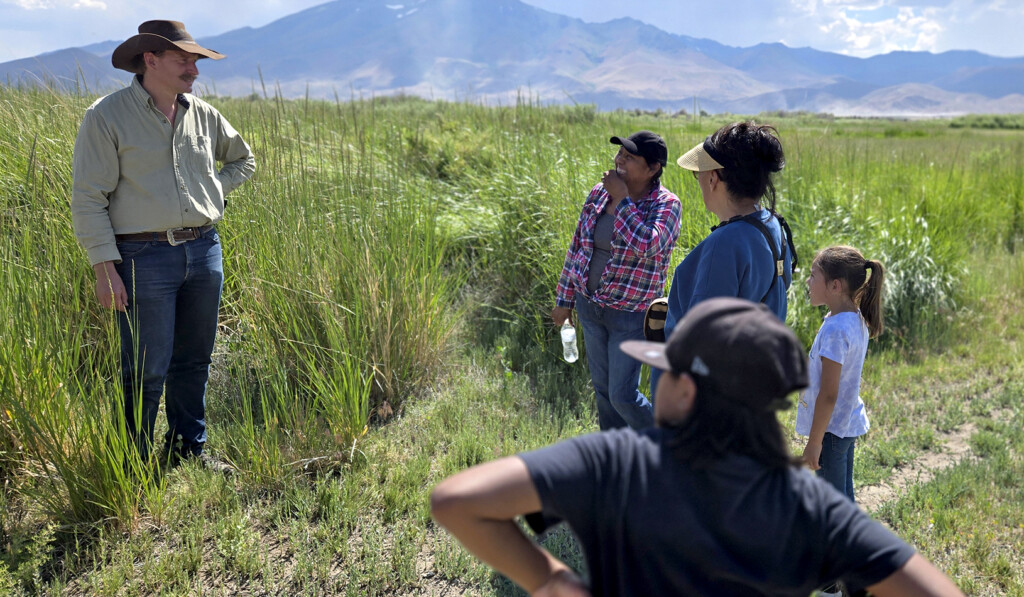
Veyrié is dedicated to helping the Northern Paiute piece back together the mosaic of their history and culture. As a student of their language and a tireless advocate for its maintenance and revitalization, he is excited so many members of the Tribe still speak their Native language. “This is what I love about this part of the country, the language is still alive,” he says. “Lots of memories, lots of Indigenous wisdom have been retained. Yes, there is sadness to their history, but Paiutes today are four generations removed from colonization by settlers.” In working with current generations, he observes two common themes that have endured and still intimately connect their culture and language: community and spirituality.
After being at Fort McDermitt for a while, Veyrié realized it was “inadmissible for a man in the community not to be a hunter.” He confesses his first attempts to bag a jack rabbit were, well, challenging, but after a season he became more skilled. He learned, according to Paiute tradition, the first of any species you kill you give away to the community. “If we think as Paiutes do, the hunter is there to serve the community first.” The word “community” is used in the broadest sense. It not only refers to humans, but to all things, seen and unseen. The Northern Paiute view themselves as part and parcel of the land. “At the interpretive level, the Indian body merges with the Great Basin,” writes Veyrié in his doctoral dissertation. “Landscape has humanlike features, canyon is a mythical character, places have dwellers of their own. As such, what is commonly called multispecies ethnography should not be limited to the realm of the living, but [should] study the realm of the animated, including not-always-visible nonhumans.”
He recalls working in Burns, Oregon, with a woman who was one of the last people who spoke the Wadatika dialect. He accompanied her to visit some caves Paiutes believe to be inhabited by ghosts and spirit beings. In her prayer, rather than petitioning they be banished or harmed, she simply asked those beings to stay right where they were. “She asked the nonhumans to stay there, not to come home with us. She told them that the caves are their home, acknowledged them as place-dwellers.” His implication was by doing so she had ensured they would not leave the cave, would not come and disrupt the lives of humans.
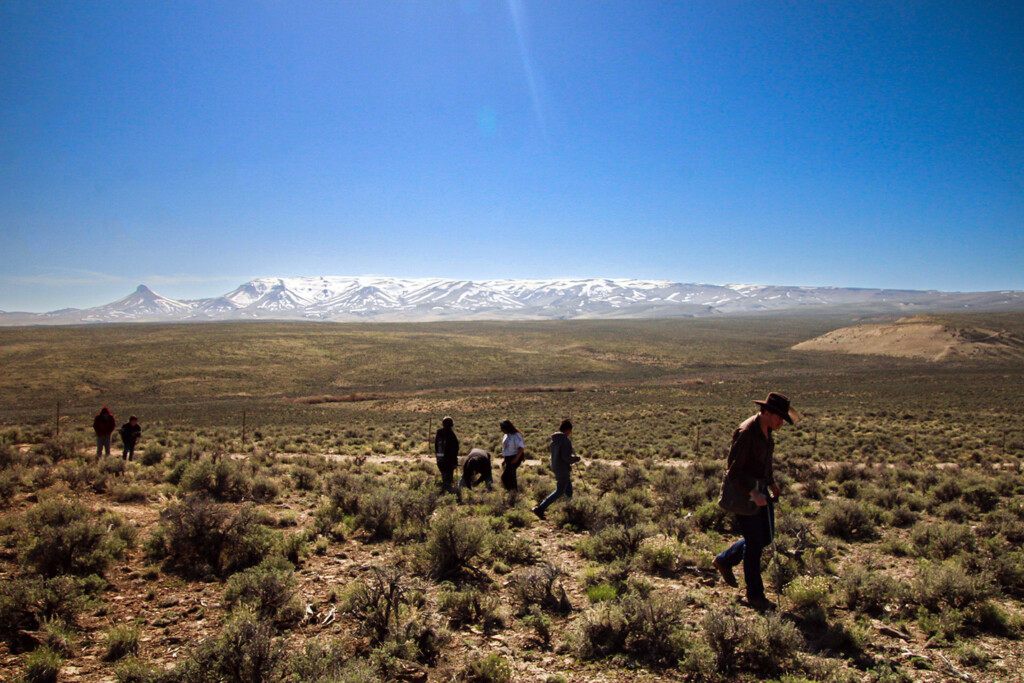
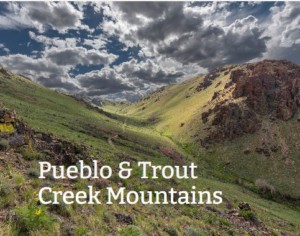
In contrast, Disaster Peak, in the Pueblo Mountains of southeastern Oregon, is a sacred site for the Northern Paiute. With Oregon Desert Land Trust now involved in its management, it is “exciting to anticipate a stronger relationship with the Northern Paiute on Disaster Peak.” Meanwhile, according to Veyrié, the Paiute prayer offered there is an invitation to the sage grouse, the wild onions, the Lahontan cutthroat trout to stay there, to thrive there, because it is their home.
What Veyrié refers to as “a profound level of acknowledgement” as characteristic of Northern Paiutes is also true in their spiritual practices. In the Paiute culture, he says, “you pray in the morning, before you gather roots, before you eat.” The Paiutes are known for the Ghost Dance, an ancient dance revived by a Paiute Shaman known as Wovoka who believed performing the Ghost Dance would lead to a return of a traditional way of life. He preached that by working hard, doing what is expected, the old world will come back. Despite and perhaps because of their past, “For the Northern Paiutes, hardship is a way to prayer.”
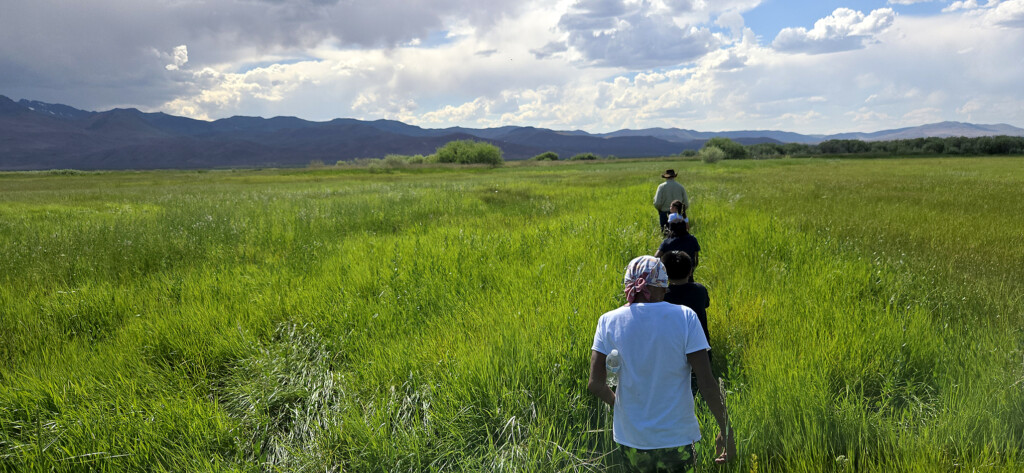
In addition to keeping an eye on the funding for the Fort McDermitt Paiute-Shoshone Tribe language programs, Veyrié’s day-to-day includes maintaining and instructing the language programs at the schools and in the community of McDermitt. He currently teaches Paiute in the McDermitt High School as well as in the lower grades. His goals are having Paiute classes to fulfill the language requirement and creating a curriculum that starts with kindergarten in order that students receive instruction in Paiute throughout their education. One challenge he has creatively addressed is the transmission of the language from elders to younger generations. Veyrié facilitates this by bringing elders and youth together to hear the Native language spoken as traditional tasks are performed. It’s an engaging form of hands-on learning that includes, according to Veyrié, “lots of field trips, resource procurement events, working on hides, processing foods… it makes it more interesting for kids.” Assisting the passing of language and traditional practices and beliefs from one generation to the next in this and so many ways, Veyrié has not only earned the trust of the Northern Paiute but has helped ensure the long life of their culture’s practices and parlance.
Veyrié’s dissertation begins with this dedication: “In recognition of our Elders who speak to us and whom we often fail to hear.” Clearly it’s time to pay attention to our Paiute neighbors in the Great Basin, to learn from them a deeper appreciation of land, place and one another. “It would be interesting,” says Veyrié, “if your American institutions and society would treat Natives the way Natives treat their community, both nonhuman and human.”
Photos submitted by Thierry Veyrié
Published August, 2025
More from the series