

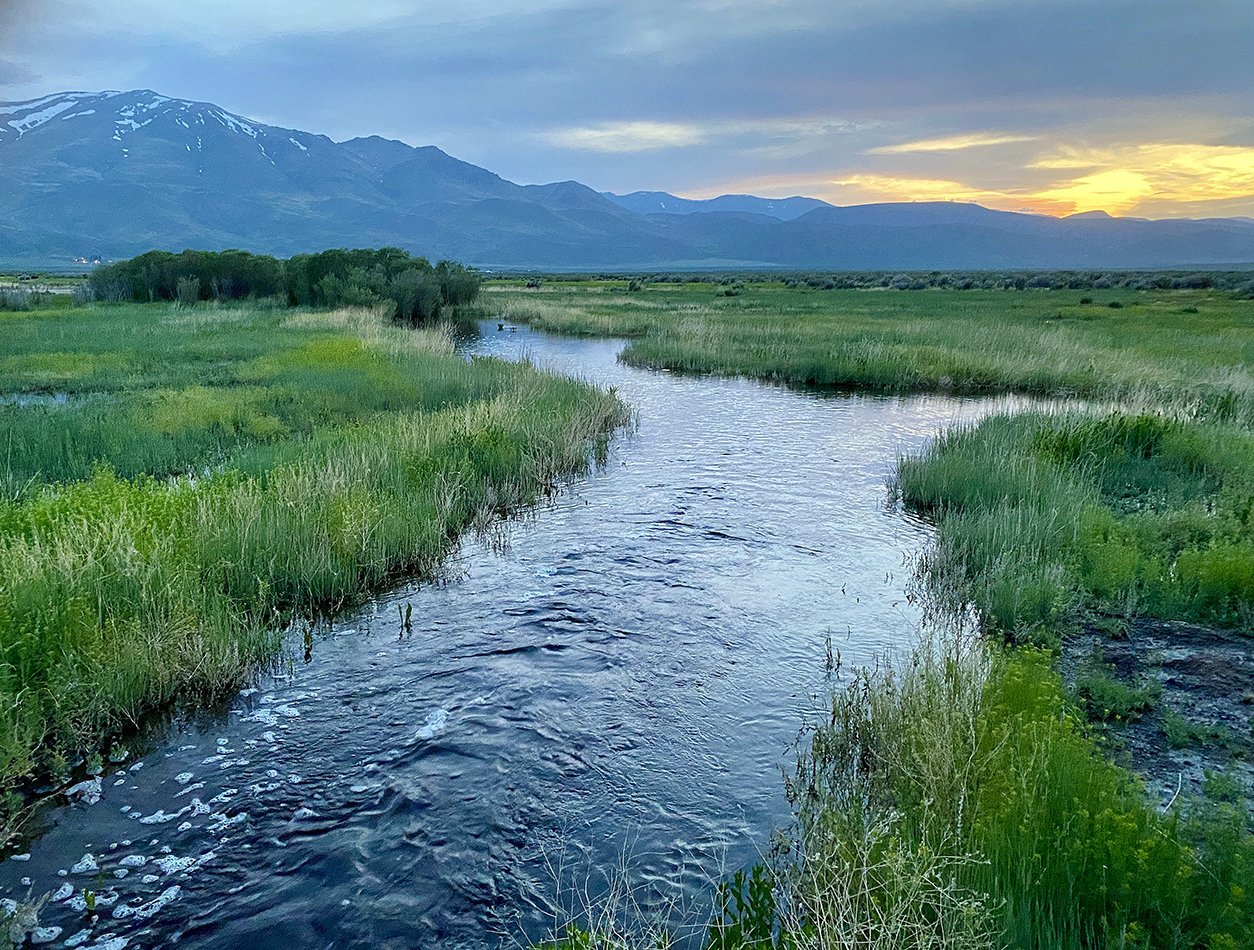
Trout Creek Ranch received its name from the creek that runs through it. It’s also an iconic ranch that supported a remote community for decades. ODLT bought the property in the summer of 2021 to connect wild and working lands for people and wildlife. Part of that work is to restore the namesake creek and nurture partnerships with our neighbors. We’re strengthening relationships and building new ones at the ranch’s homebase and through our collective conservation work. Updated facilities have helped with both, along with huge lifts from our amazing volunteers.
Trout Creek Ranch spans nearly 17,000 acres. Headquarters are nestled between the Trout Creek and Pueblo Mountains, which include some of ODLT’s private lands. These lands are scattered among public lands, in which we hold livestock grazing permits spanning hundreds of thousands of acres.
Traditionally for the ranch, cattle could be up in the mountains, down in the wet meadows, or sorted in a feedlot that was built across Trout Creek. ODLT has leased our grazing permits to local ranchers and we work together on adaptive management, providing us with opportunities to retool and rethink some of the facilities. This has enabled us to take on projects like downsizing the feedlot to a smaller staging area for cattle that can capture weed seeds before cows graze seasonally in the wet meadows, or when placing collars on cattle as part of ODLT’s virtual fencing efforts. By removing the portion of the feedlot that spanned Trout Creek, it is also allowing the aquatic system to rebound.
“We’re just jumping into the wet meadows restoration and that project is putting Trout Creek back into its original channel, which is just the tip of the iceberg,” explained Trout Creek Ranch Restoration Manager Brooke Gray. “Engineers will be submitting plans to add open water, marshland, and still give us the ability to flood irrigate the meadows, but a piece of that is the feedlot, and it needs a lot of help from years of intensive use.”
Trout Creek has taken various forms at Headquarters: a largely natural beaver-dominated system at the upstream end, a water source for a historic feedlot in the middle section, and a simple irrigation ditch as it enters the meadows. Meanwhile, the outdated irrigation infrastructure gave us limited ability to manage high or low seasonal water flows. Both situations contribute to poor conditions for sensitive fish like the Alvord chub. We’re developing a restoration vision that restores Trout Creek’s historic form and function and improves our ability to manage stream flows for maximum wildlife benefit.
Renovating the former feedlot to reduce its size and impact on Trout Creek continues to be a large project, but we’ve taken big strides. We first decommissioned the northern portion of the feedlot that ran alongside Trout Creek, and we’re replanting the floodplain with native vegetation to jumpstart recovery. Initial demolition started in 2023 with help from Tribal Steward volunteers and board members who took out heavy, metal gates that made up the alleys. In partnership with a neighboring ranch, we were able to remove 636 tractor tires (sized 7’x3’), along with other large, long and rusty pieces of the restoration puzzle.
“It was a lot of work, but was rewarding,” remembered Trout Creek Ranch Manager Andy Gray. “It’s always hard to tear out infrastructure. That takes so much time and energy, but it feels good that 90% of what was removed was reused.” For Trout Creek Ranch Assistant Zak Morgan, it was bittersweet.
“I tore a bunch of it out and had fond memories of actually working in it. I was probably 12 or 13 the first time I rode in there,” Zak recalled. Those memories, and many more, remain with the salvaged remnants on site. Some corral boards became partitions for the backdrops to planter beds, while others upgraded pens for sorting cattle seasonally. All of the work is for the future, but there are plenty of nods to the past around the ranch.
As the last pieces of the feedlot came down this year, wildlife friendly fencing went up around its perimeter. The same occurred in the wet meadows, thanks to a volunteer crew this spring. Replacing the bottom barbed-wire line with rounded wire reduces injuries to pronghorn and other animals who can now pass beneath a smooth low wire.
While outdoor activities were in full swing, plenty of helping hands assisted indoors, too. In our first and second years, there was tireless work to update living quarters and tool sheds, and to create a dedicated meeting space for partners and staff. The last two years involved converting an oily, old barnshop into a clean, new gathering space. Paul Spezza was up to the task, and so were members of his construction crew and a handful of friends. His love for the high desert and the people within it had him trade his time and skills for the opportunity to make a difference.
In the heat of the summer and the middle of mosquito swarms, a barn became a bridge to building community. The insides were gutted, then filled with insulation, cedar and electricity (and likely some blood, sweat and tears).
A crew of caring folks spent hours retrofitting a future place for people to gather, both for work and play. It was rebranded as The Lek, in homage to the gatherings of sage grouse, and has a whole new look and feel.
“It was a big transformation from what it was to what it is,” expressed Andy. “That was a feat.”
“It was really fun and I appreciated being able to go there and do what needed to be done,” beamed Spezza. “All my guys loved coming out there. They had a ball and we’ll do some more if we need to.”
We wasted no time filling this new space with lots of activity and loads of laughter. Shortly after the conversion, we hosted a Tribal gathering for more than 20 people. Friends and families slept over for the weekend and The Lek became a dining hall with pancake breakfasts, traditional dinners, and good company, in between trips into the mountains and closing campfires. The following weekend was full of other indoor and outdoor fun with nearly forty neighbors at our first picnic. Since then, it has been used by dozens of people and partners like the Rangeland Fire Protection Association. We were excited for the great start and will be hosting more valuable events in the years ahead.
We have plenty to celebrate with the community and now have a place to do it. In addition to horseshoes, roping, and bocce ball games outdoors, we also have a space for darts, ping pong and cornhole tournaments to be part of the fun, or a respite during bad weather.
Brooke agrees. “The community has embraced it, too,” she feels.
Big lifts happened on the feedlot and The Lek, but the list of projects is still long, from wetland restoration to virtual fence and regenerative agriculture. As these projects are completed, we look forward to having more to celebrate.
Morgan grew up in the Fields Basin. He knows the area inside and out and considers it a cool country with good people. He’s been a cowboy, cowboss and livestock manager throughout the west, so he’s enjoyed getting his hands dirty to clean up the ranch. He’s happy to work alongside Brooke and Andy and feels the impact of projects outweighs the size of them.
Andy and Brooke are team players who are too humble to take all the credit, but we’re grateful for their leadership. They stepped up to the plate after managing a preserve on the Upper Crooked River for a decade and brought along their professional and family experiences with rangelands, project management, and plenty of humor.
All ODLT efforts are team efforts by staff, volunteers, partners, neighbors, and many other supporters, who are all considered friends. These collaborations keep us motivated and inspired by a shared vision that benefits people and wildlife of the high desert. We appreciate all that has brought us to this thankful moment and look forward to the next big thing, plus all the little ones in between.
Ongoing thanks go to each and every one of you! Your special support makes Trout Creek Ranch such a welcoming and impactful place!
Feature image: Trout Creek flows into the meadows after a wet spring in 2023 at Trout Creek Ranch. The Pueblo Mountains lie to the west. — Kharli Rose
Published August, 2025
Learn More
- View maps and access information in our Visitor Guidelines for Trout Creek Ranch.
- Discover more about the project area and how it all fits in our strategic plan.
- Revisit how Tribal Stewards worked on the feedlot, bird surveyors assisted the wetlands, and how facilities help with hosting Tribal gatherings and Rangeland Fire Protection meetings.
- ODLT is on the verge of acquiring Disaster Peak Ranch, which lies adjacent to Trout Creek Ranch. Combining the two efforts will expand the total project size to nearly 600,000 acres and continue to grow one of the largest conservation projects in all of Oregon.
Stay Tuned!
- We’ll keep you posted on updates and opportunities at Trout Creek Ranch and Disaster Peak Ranch in our monthly online newsletters and on our volunteer page.
Discover details of the highlighted regions
View Wildlife Camera Videos
More perspectives
Related Reads
Desert Duet
A conversation with SageCon Coordinator Rachael Davee & Oregon Department of Fish & Wildlife Biologist Andrew Walch — Redmond, OR
Be the Mountain
A conversation with Jenner & Harland Yriarte — Steens Mountain High Altitude Running Camp Organizers — Frenchglen, OR
A Summer to Remember
College interns were a huge help over the summer.
A Range of Change
Trout Creek Ranch updates help conservation and community.
Grouse Count
We've joined in state surveys of greater sage-grouse.
Reaching for new heights in conservation
Together, we can conserve Disaster Peak Ranch!
A land of learning
Local Tribal members shared stewardship practices to inspire youth.
Looking out for the birds
Volunteers help guide restoration plans with wetland bird surveys.
Watching wildlife
Wildlife cameras help with conservation plans for animals throughout the year.
Virtual fences mooove cows online
Virtual fence is a new technology that can help land managers maintain wildlife connectivity in permitted grazing areas.
Tribal Gatherings
Tribal leaders discussed the Native history and stewardship of their homelands at Trout Creek Ranch.
Research fueled by fire
Oregon State University finished 10 years of fieldwork on sage-grouse responses to wildfire.
Tribal Stewards
Tribal teens lead on conservation efforts through Northwest Youth Corps.
Spring returns
Rod Klus returns to researching sage-grouse for Oregon Department of Fish and Wildlife.
Mountains of Research
Researchers spent a summer in the mountains and left with more than data.
Spreading wings in conservation
Jack Strang created new connections to the high desert during our first internship.
Neighbors helping neighbors fight fires
Rangeland Fire Protection Associations protect the high desert and each other.
Watching for wildfires
A live camera on Beatys Butte helps wildfire efforts in the high desert.
Spring into recreation & conservation
John Sterling works at the intersection of both as a volunteer board member.
Balancing a range of concerns
Angela Sitz brings wild and working lands together.
Wildlife encounters
Land Trust volunteers are keeping track of animals on the ground and on camera.
Keeping it connected
Closing the unnatural gap between wildlife refuges opens doors for pronghorn.
Seeing the land in a different Light
Northern Paiute Tribal member Wilson Wewa brings a Native perspective to ODLT's work.
