
A Conversation with Cindy Talbott Roché
Botanist, Illustrator and Author
Bend, Oregon
by Ellen Waterston
“I would like to know the grasses and sedges—and care. Then my least journey into the world would be a field trip, a series of happy recognitions.”
—“Pilgrim at Tinker Creek” by Annie Dillard
As ubiquitous as it is, grass generally goes unnoticed. Oblivious, we walk through, on, and across it but don’t really see it or acknowledge it. Most of us have little to no grass vocabulary and don’t care. The fact is, we don’t know what we’re missing.
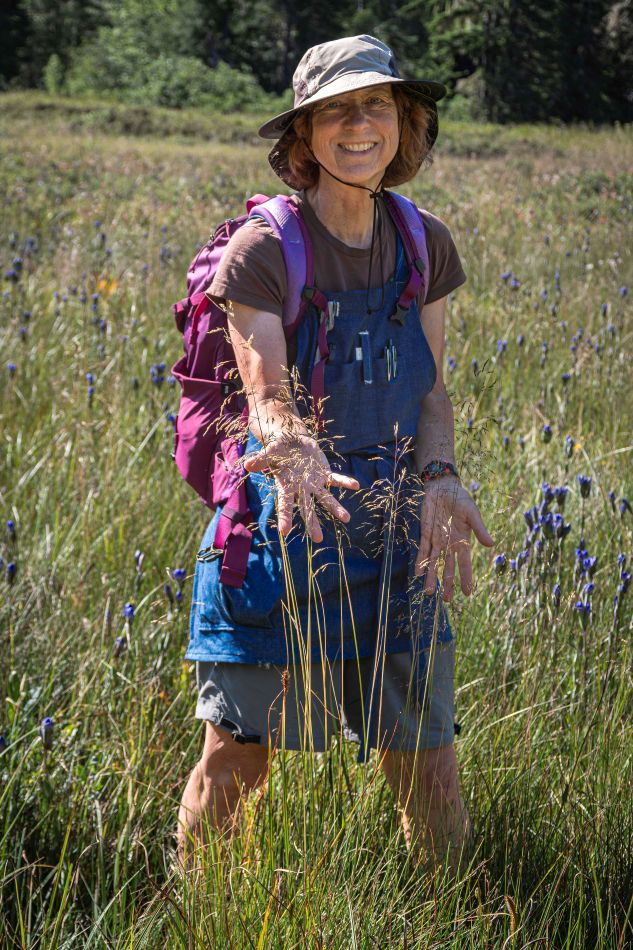
Thankfully, Cindy Roché does know. One of her current passions is to bring the rest of us into a deeper awareness and appreciation of our Poaceae (grass family) friends, both the native family members and the uninvited grass guests that make Oregon’s high desert and the Northwest their home.
If you go on a hike or enter into a conversation with this passionate botanist, you’d better be ready for a magical mystery tour through the kingdom of grass. In the space of our conversation, I learned words new to me such as “relict” defined by Cindy as “a remnant plant population that has survived from previous climates or ecosystems.” I marveled at the zany beauty of botanical words like scilliate[1] or scabroole[2], glaberous[3] or spikelete[4]! Move over, Dr. Seuss!
Cindy’s love of the outdoors started on a small farm near Lewiston, Idaho. Her first 10 years were spent on the family’s Lewiston, Idaho, farmstead complete with gardens, fruit trees and the requisite farm animals. By the time she was five Cindy could milk a cow. The family subsequently moved to a 400-acre working farm near Chewelah, Washington which further cemented Cindy’s interest in all things growing.
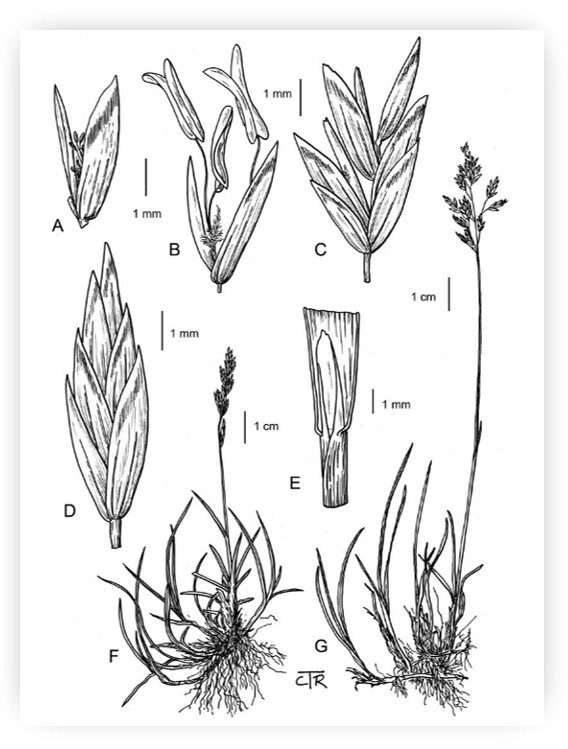
Cindy went on to earn both a Bachelor of Science in Forest Management and a Master of Science in Range Ecology from Washington State University (WSU) and, afterwards, married Dr. Ben Roché, the WSU Extension Range Management Specialist. She was soon working at WSU Cooperative Extension writing Pacific Northwest Extension Bulletins on noxious weeds, illustrated with her photos and precise botanical depictions. The experience not only honed her skills as an illustrator, but also, as Cindy says, “taught me the writing skills I needed to interpret science for lay people.” Her interest in invasive weeds next led her to a PhD program at the University of Idaho, which she completed in December of 1996. Six months later her husband Ben died, leaving her a widow at 42.
As fate would have it, a condolence letter from Bob Korfhage, one of Ben’s long-time friends, set in motion a correspondence that prompted Cindy to relocate to Medford, Oregon. There she began a new life with Bob as her “adventure partner” as Cindy describes her second husband. She wasted no time in becoming involved with the Siskiyou Chapter of the Native Plant Society of Oregon, quickly making friends with fellow botanists and securing a job illustrating grasses for the “Flora of North America.”
When Bob retired from the Bureau of Land Management in 2003, he and Cindy decided it “might be fun” to write a field guide to the grasses of Oregon. They teamed up with a well-known group of botanists known as the Carex Working Group (Barbara Wilson, Dick Brainerd and Nick Otting). It became quickly evident a field guide of this magnitude was more than enough work for five people. “It was essential to have the Carex Working Group’s taxonomic expertise,” says Cindy. “They have described a number of new grass species in Oregon, including two on Steens Mountain. One of these was Steens Mountain reedgrass: Calamagrostis utsutsuensis. In naming it, Barbara and Nick wanted to honor the Tribal People as they would have already known about the grass. Utsutsu is the Burns Paiute name for Steens Mountain.”
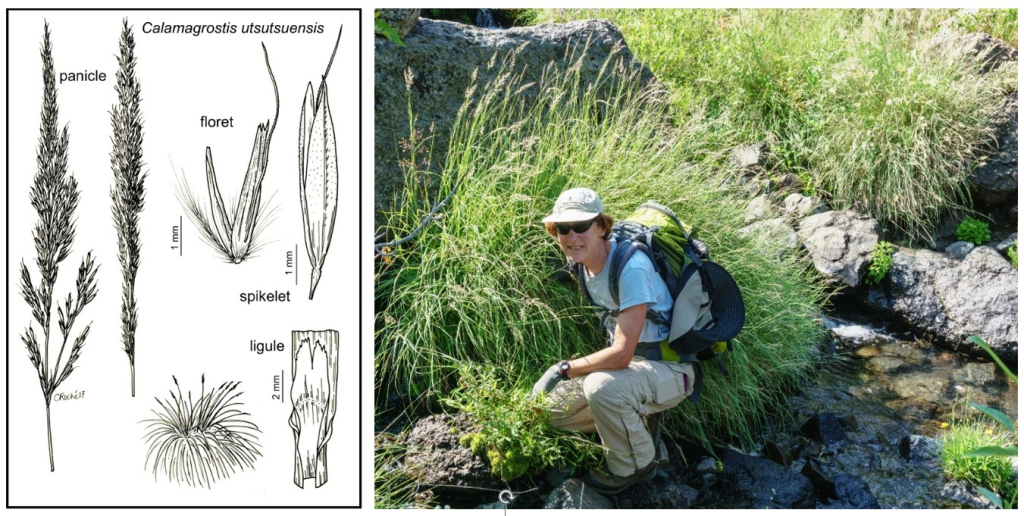
This collaboration for a grass field guide led to needle-in-the-haystack hunts for grass species all over Oregon and Washington. “Exploring, camping, seeing what’s out there, being able to go places where I don’t see crowds of people … that type of adventure is my passion.”
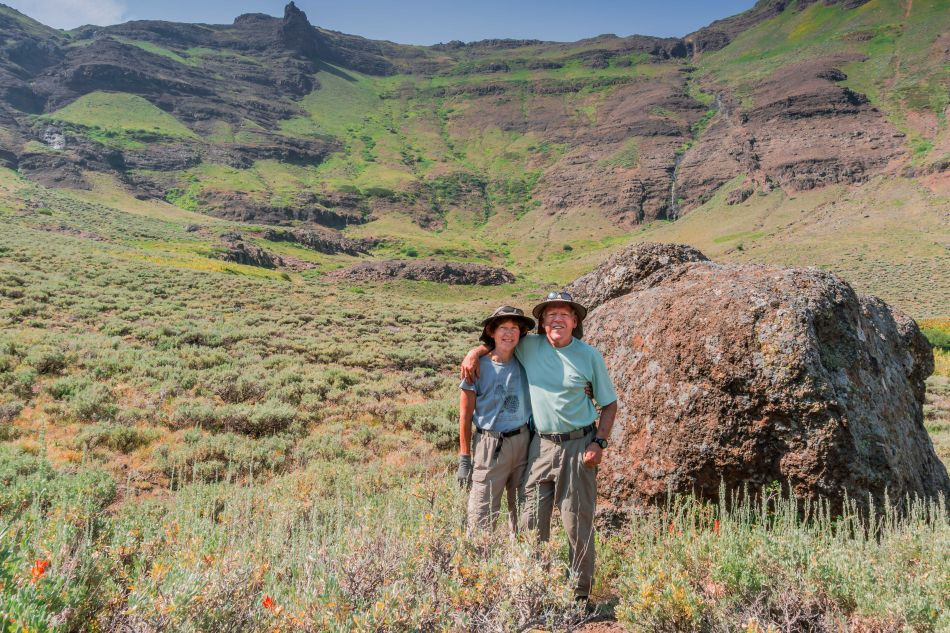
Cindy’s first southeastern Oregon adventure was a 1998 backpacking expedition with Bob into Big Indian Gorge on Steens Mountain (where he proposed to her). They returned in 2018 and were not only delighted to see improvement in the health of vegetation under management as a Wilderness, but to discover least muhly, Muhlenbergia minutissima, growing in a seepy area over a basalt ledge on one of the canyon walls. This species had not been recorded in Harney County. Cindy had never seen it in the wild before, as all but two of the previous records in Oregon and Washington dated back to the 1800s. “This is what excitement looks like to plant geeks,” she admits.
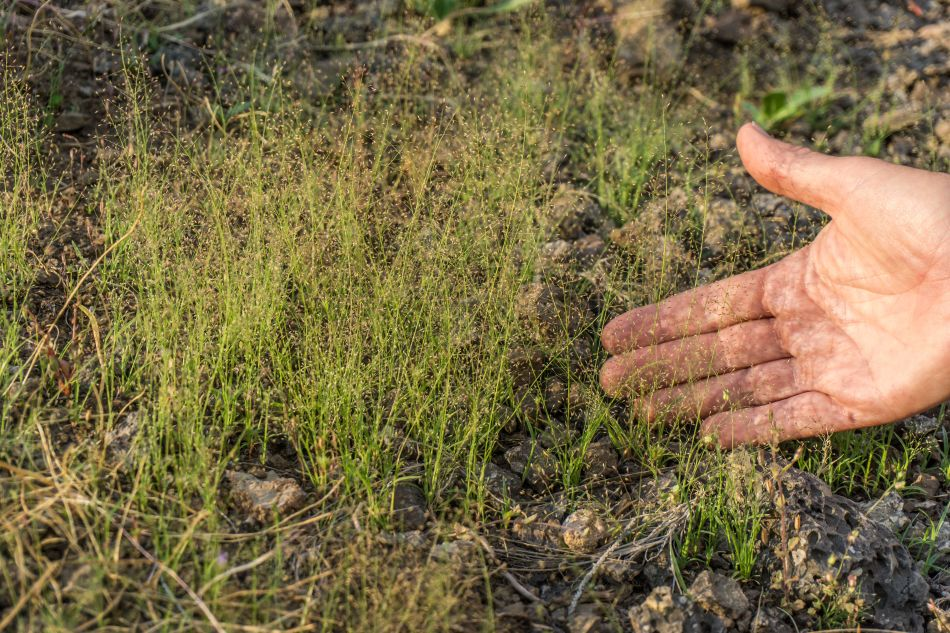
The first edition of the “Field Guide to the Grasses of Oregon and Washington”was 17 years in the making. It sold out in less than five. The second, released in 2025, covers everything from “weedy invaders to rare native species,” along with current names, maps and photos, all with detailed descriptions. It debuts 18 new species for a total of nearly 400 plants illustrated by the couple’s photographs and Cindy’s drawings.
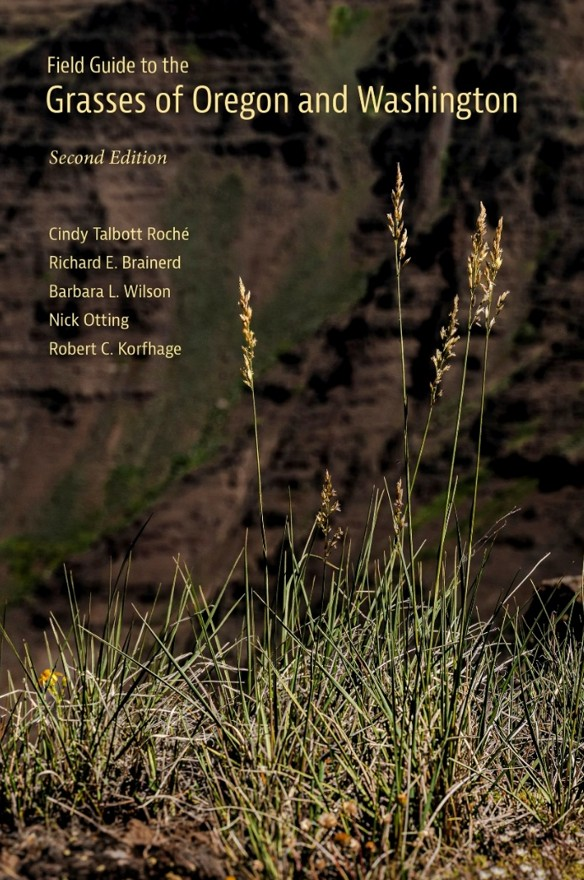
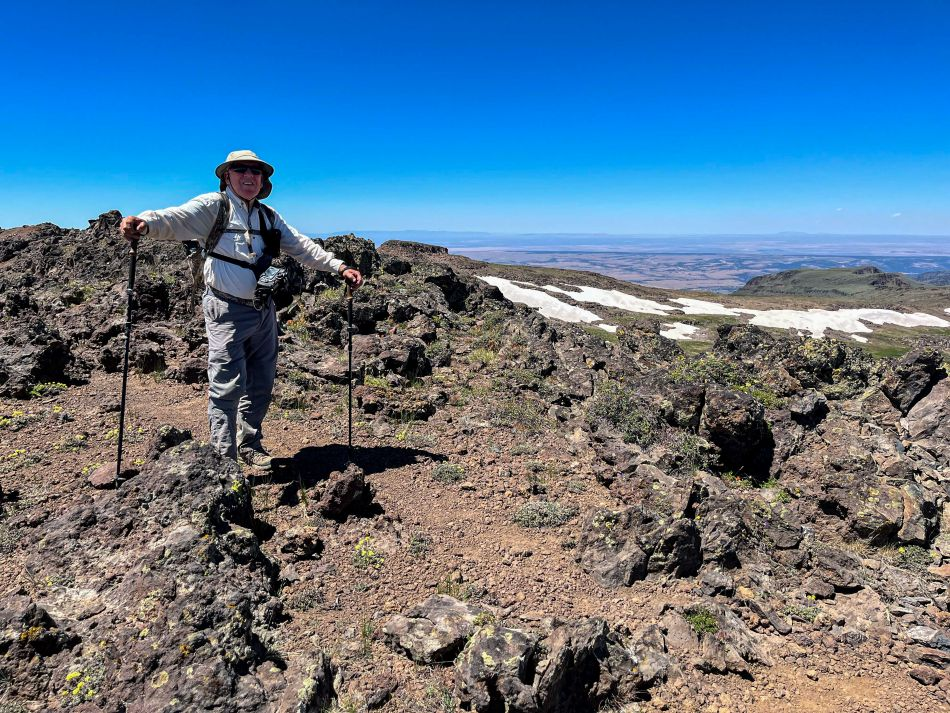
Research for the second edition resulted in more adventures for this energetic couple and more grass images, including a new cover photo. “The only Oregon location of Leucopoa kingii, a Nevada grass, is reached by hiking out a knife-edge ridge beyond Little Wildhorse Lake on top of Steens Mountain,” Cindy relates. “With my encouragement, Bob managed the hike with a knee brace and trekking poles and took the photo that graces the cover of the second edition. Later that year Bob had a knee replacement, so in late June 2023, Bob and I went to Domingo Pass in the Pueblo Mountains to find King’s eyelash grass,” recalls Cindy. “It grows in California and Nevada and our friend had seen it in Oregon, but not collected it.” They set off hiking, but strong winds came up in the afternoon, and the pair decided to turn back and set up camp. “The next morning we woke up to snow around our tent,” recalls Cindy, “and we had to leave before the wet roads became impassible. We’ve not been back, so if someone wants to bag a new state record, the opportunity is still there.”
“I know it sounds like perhaps the only plants I notice in the desert are the grasses,” Cindy muses. “But that isn’t really how I’m thinking when I’m out there. I often think about the perfect synchrony of the plants to their environment.” She offers an example: “Lomatium (biscuit root) and bitterroot don’t experience this drought year. They come up early, flower, set seed, and replenish the food reserves in their roots before the weather gets hot and the soils dry out. The entire rest of the year they are dormant. Like nine months of just sitting and waiting for the next late winter or early spring growth period. The patience of plants! Other species have different cycles, but all of the plants native to this area have ways to deal with periods of drought and other cycles of weather.”
Cindy and Bob became strong Oregon Desert Land Trust advocates after “participating in a lek count for greater sage grouse in the Trout Creek Mountains, and learning about the work ODLT was doing in the northern Great Basin in southeastern Oregon: Trout Creek Ranch, the Pueblos, and Hart Mountain. I like how ODLT is working to repair the damage to the ecosystem and restore habitat and corridors for wildlife migration and is consulting with local Tribes.”
Cindy continues: “The idea of invasive species is complex. The new species (including us) are here to stay and the Native Americans accept that. We, however, need to change our management practices that damage native species and create conditions for cheatgrass and other invaders to thrive.”
“The culture of the Native peoples developed over thousands and thousands of years in this environment, just like the native plants and animals evolved to thrive in these ecosystems. When colonizers came from other parts of the world, they brought a way of life that developed in a very different ecosystem and they found the desert to be a harsh and difficult place in which to survive, unlike the people who had always lived here.”
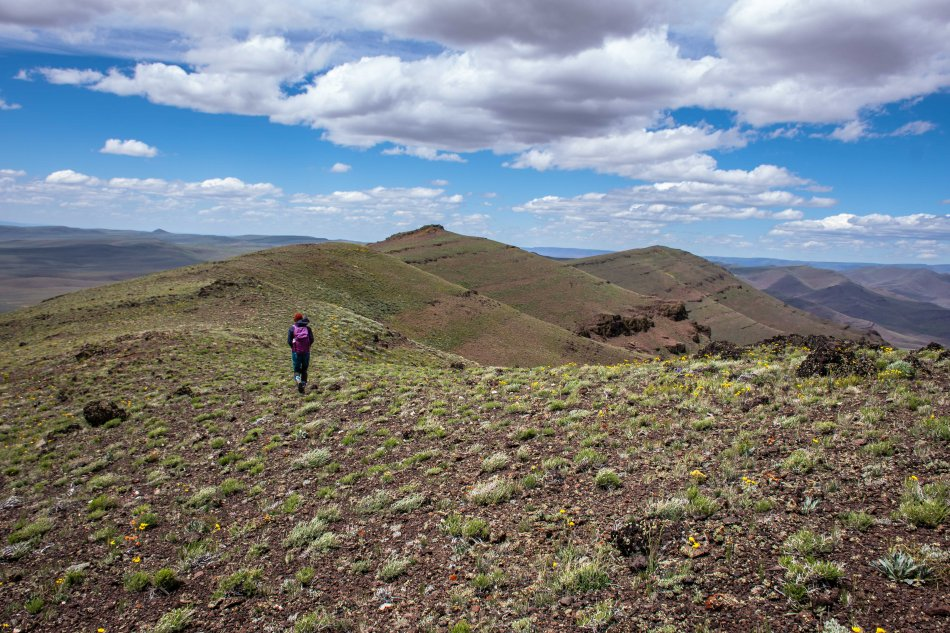
What’s Cindy’s next project? Without a moment’s hesitation she proclaims, “More graminoids! Graminoids,” Cindy explains, “are just one of the unsung heroes of the green world beneath our feet. We tend to see what we know, so if people learn grasses, their eyes are open to so many other things as well.”
Her wish for us all? “…to see that meadow isn’t just a carpet of green. It’s a sophisticated filter for our water, a buffet for wildlife, and a master class in structural engineering. Once you learn that you’re not just looking at ‘grass’ you can start learning the language of the landscape and appreciate even the parts that aren’t visible to us. Who knows where it will take you?”
[1] ciliate: fringed with short hairs
[2] scabrule: a tiny scaber (small hard projections on a plant surface that feel rough)
[3] glabrous: lacking hairs
[4] spikelet: basic unit of a grass inflorescence (glumes and one or more florets)
Photos provided by Cindy Roché
Published June, 2026
More from the series