
A Conversation with Sue & Stan Shepardson
Owners of Rinehart Ranch
Bend, Oregon
by Ellen Waterston
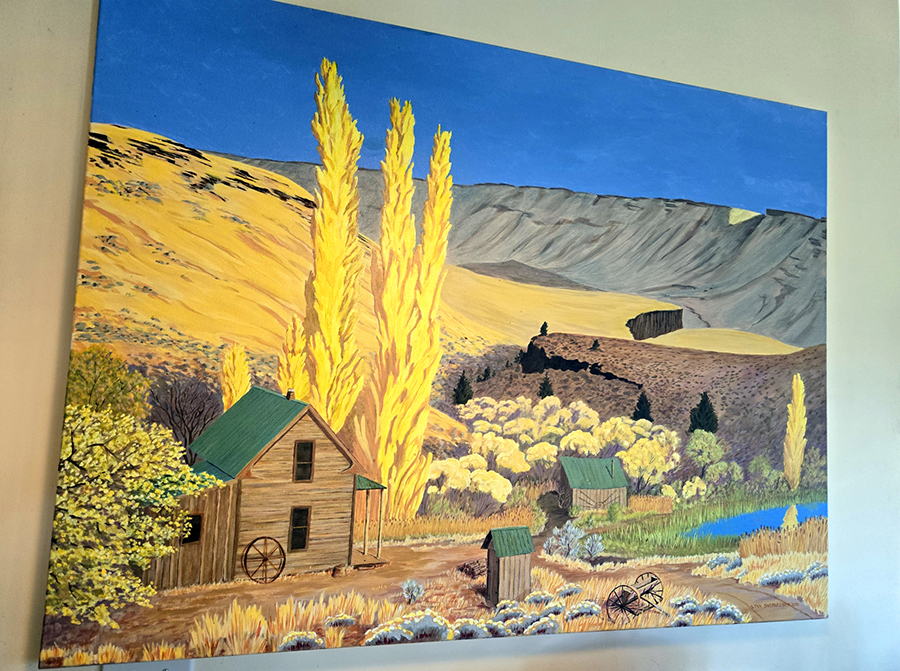
Entering their house on acreage east of Bend, Oregon, I was taken by the paintings of high desert landscapes hanging in Sue and Stan Shephardson’s living room. They had a singular style, at once figurative and abstract, bold with color, compositionally compelling. As we chatted our way into the kitchen another painting, the rendering of an old homestead, caught my eye and was immediately my favorite.
The artist’s palette captured the sere, brittle dryness of early autumn in Oregon’s Outback—the gold of the grass-covered slopes that cradle the lonely outpost, frothy rabbitbrush white with heat exhaustion next to straw-toned clumps of bunchgrass, steeple-like poplars painted in sun-scorched yellow, and, nestled against the side of the house, fruit trees dressed for fall in rusts and ochre. Skillfully rendered was the familiar way dark lava exudes from grass-mottled slopes, the small shadows of the low-riding desert. The gabled homestead is seemingly indifferent to the precariously close cliff and sheer escarpments looming in the background. And then there’s the surprise of emerald grass circling a bright blue catch pond in the lower corner of the canvas, confirming what the poplars, fruit trees and bunchgrasses knew all along. There’s water here, coming somehow from somewhere. This is a secret garden of the high desert. It turns out Sue and Stan know a thing or two about this secret garden. But first, something more about the artist.
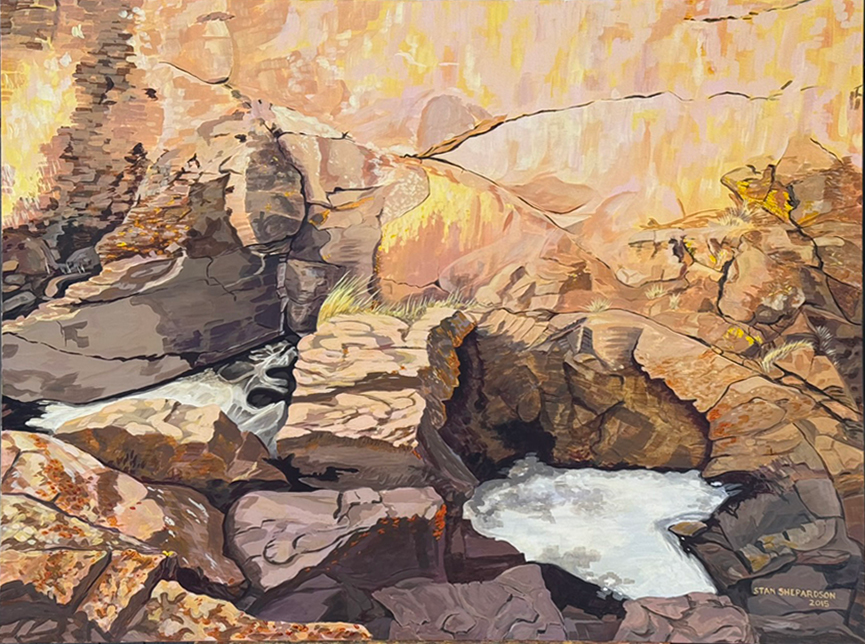
After nearly six decades of practice as an ophthalmologist, when he retired, Dr. Stan Shepardson returned to a former passion, painting. His affection for each landscape is evident in the exacting and balanced proportions, the perspective and point of view reliably keen and true. All told his paintings serve as an illustrated journal of Sue and Stan’s desert years. They are the perfect accompaniment to the countless photo albums Sue has meticulously maintained, each image homage to their many adventures in the desert they love and important anecdotal evidence of an ever-changing biome.
These two weren’t always desert rats. They both grew up in Portland, even attended the same high school, although weren’t on each other’s radar at the time. After all, Stan was two years ahead of Sue. In high school that’s eons. But all that changed when the two connected at the University of Oregon as undergrads. You guessed it. First came love, then marriage, then, eventually, Stan and Sue pushing the baby carriage.
They’re the devoted parents of two and delighted grandparents of four. By the time Stan graduated from the U of O, he’d committed to becoming a doctor and had enrolled at Oregon Health & Science University in Portland. Sue transferred to Portland State University to complete her undergraduate degree, subsequently teaching American history at the high school level to put her husband through medical school. She was an adherent of the representative democracy the founding fathers intended and she stood up for those rights. “I was political at the time to say the least,” she says. The Vietnam War was raging when Stan started the first year of his residency. He was commissioned to serve for two years as a general medical officer at the Spokane Air Force Base. During that time, Sue, pregnant with their second child, was among the first of the wives to sign up for a protest march against the war to be held on the base. “Vietnam colored our experience. All of us realized the government wasn’t telling the truth.” She pauses. “And now?” But her protest plans for that day were unexpectedly foiled. “Our second daughter decided to come early,” she reports with a shrug and a smile. In the aftermath her egalitarian convictions were only strengthened by the response of higher-ups on the base. “The husbands were called in front of the base commander who told them to manage their wives and dogs.”
The couple then moved to Wisconsin for three years while Stan completed his residency, at which point, they had to decide where to settle permanently, a location where Stan could establish a practice in his chosen specialty, ophthalmology. They knew they wanted to return to their home state with their young family, but where? Their years in Spokane had given them a taste of life on the drier side of the Cascades and they’d liked it. So when an opportunity became available in Bend, they didn’t hesitate. They soon found acreage situated outside of town giving them ample room for gardens, a house, some pastureland, a corral and horse barn.
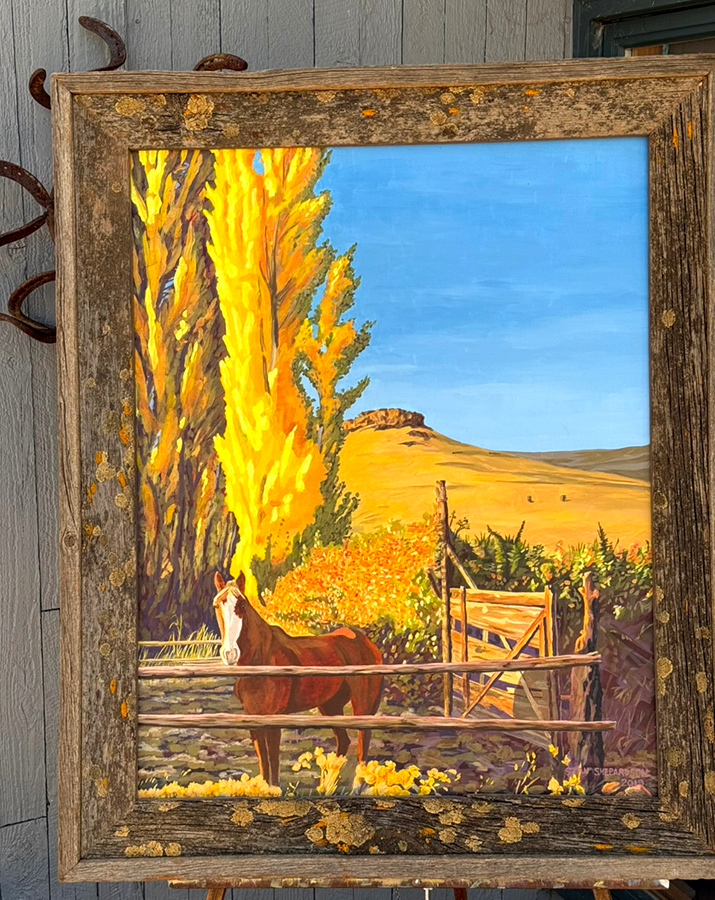
“We’ve always had horses,” says Stan. “Horses became a part of our lives when our girls were in middle school and wanted a 4-H project!” recalls Sue. Indeed, this venturesome couple has explored the West on horseback, bringing their children and grandchildren along on multi-day pack trips in Idaho, Wyoming, Montana and throughout Oregon’s high desert. For these long rides they favored gaited horses and for years rode the Tennessee Walking Horse, recently switching to the smaller Kentucky Mountain Saddle Horse. Nowadays Stan rides more than Sue, volunteering to help with trail maintenance in national forests. One thing he carries with him on his excursions, more as a reminder of Sue’s affection than an effective remedy if he gets in a jam, is a whistle she gave him early on in their marriage as she came to understand and appreciate the explorer in her husband.
Where and when does a love of the high desert first take root? It goes without saying it’s different for each of us. It might be as simple as a ritual outing with a parent or a camping trip in a part of the world you’d never seen before. Sue, whose parents “weren’t outdoor people,” discovered her love of wild places in high school where she was part of an all-girls group that took a week-long, self-supported backpacking trip somewhere in Oregon each summer. “The Wallowas were my favorite,” she says. She recalls that week hiking in the mountains, camping at lakes, carrying everything she needed, the freedom, the self-sufficiency. Her athleticism, daring, and insatiable curiosity has been her power bar ever since. As for Stan, his father liked to fly fish the Deschutes River, track mule deer out of Heppner, or hunt chukar in remote reaches of the high desert. Lucky for Stan, he took his son along with him. Of the three, it was chukar hunting in Oregon’s Outback that got Stan’s attention. “As a result, we’ve had many hunting dogs,” says Sue good-naturedly, letting a gleeful English Setter into the kitchen who, after some coaxing, settled at our feet. Sue is generally game for any adventure with Stan, although sometimes takes a pass on some of the hunting trips. “I don’t hunt. I have never shot anything,” she says. “You once shot a paper plate,” counters Stan with a laugh.
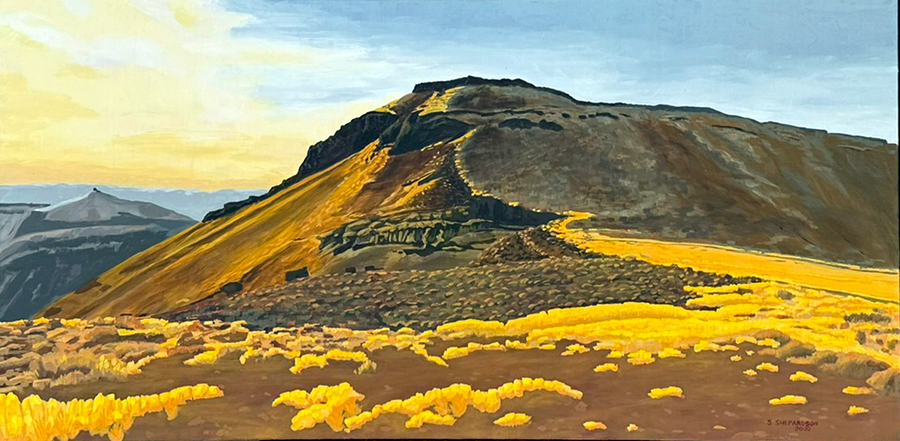
On one of his solo chukar hunting trips decades ago, from across the Owyhee River, he spied the roofline of an old house on a bluff and below a thriving riparian area. “Made it really special,” he recalls. He’d never noticed them on previous trips and promised himself he’d return with Sue to learn more. Sure enough, they were soon back scouting the property and finding an abandoned house, remnants of a corral, an outhouse and a root cellar. Generous springs flowing from the nearby hillsides delighted them as did evidence of elk, bighorn sheep and ancient traces of Native Americans. Smitten, when the two got back to Bend, they researched the current ownership, hoping to gain permission to return. Through a convoluted and, in the end, lucky series of events over several years, in 2003 they became owners of the property.
Home sweet home! “No roof, starlings living inside, pack rat droppings six inches deep, the only insulation … musty newspapers dating back to 1936,” Stan says. Sue confesses her first thought was “to set a match to it,” but what happened instead is like something out of “Little House on the Prairie.” “It went from ‘burn it down’ to ‘oh, well’ to something we’d never give up,” says Stan.
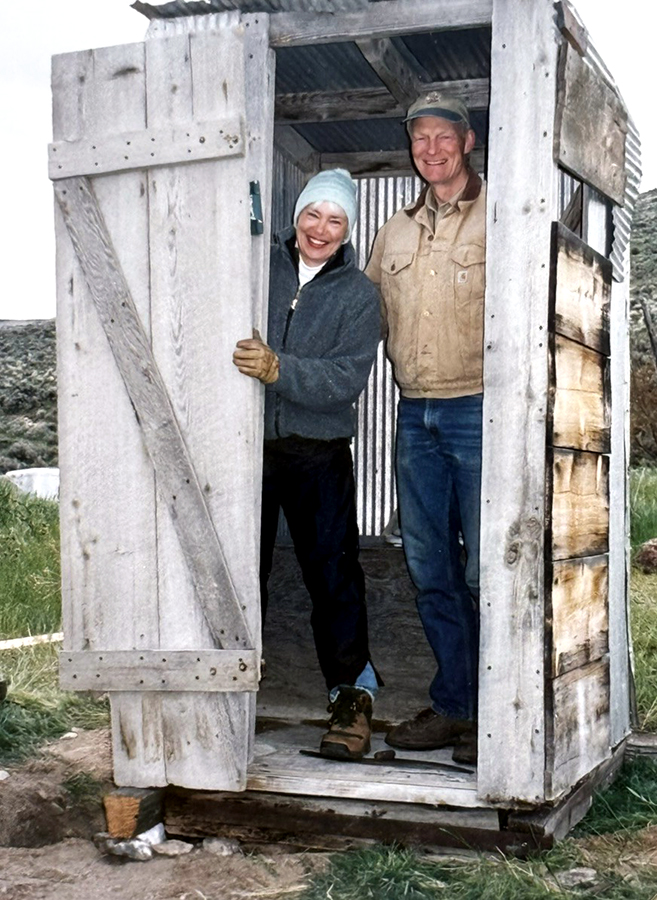
They discovered the house had been built using what’s known as vertical plank construction—long plank boards stood on end and overlapped for structural strength, eliminating the need for framing. Instead, the planks (each 15 feet tall in the case of Stan and Sue’s homestead) are fastened between a bottom sill and a rafter on top. The kitchen had a wood stove and cabinets. In the early 1910s, all the building materials and household needs—the stove, bedsteads and mattresses, dishes, kitchen utensils—would have been hauled by wagon over miles of rough dirt roads. There was a water pump but no indoor plumbing. Instead, the two-holer outhouse served as the loo. “Stan calls it a .5 Star Hotel,” says Sue. Stan wryly explains, “You can’t go above a .5 star if there’s no indoor toilet.”
What happened next was a contemporary version of Tom Sawyer’s approach to getting a fence painted. Make it fun! Stan and Sue’s friends found themselves clamoring to travel the six long hours from Bend in order to saw, hammer, clean, scrub, prune, mow and till. Non-carpenters became carpenters; as the orchard was resurrected, meadow restored, root cellar shored up, and water piped from the spring, botanists, zoologists, hydrologists, and ornithologists were born. Former strangers to the desert became zealots. A roof and a door were put on the concept of salvaging, honoring, renewing and preserving; of working as a team for something good just for the heck of it. Stan and Sue now go at least three times a year. “That’s because basically we’re chukar hunters,” explains Stan. “No,’ says Sue, “you are,” clarifying that she goes for the pristine darkness, the night skies, the calm, the seasonal bird migrations and breathtaking displays of wildflowers.
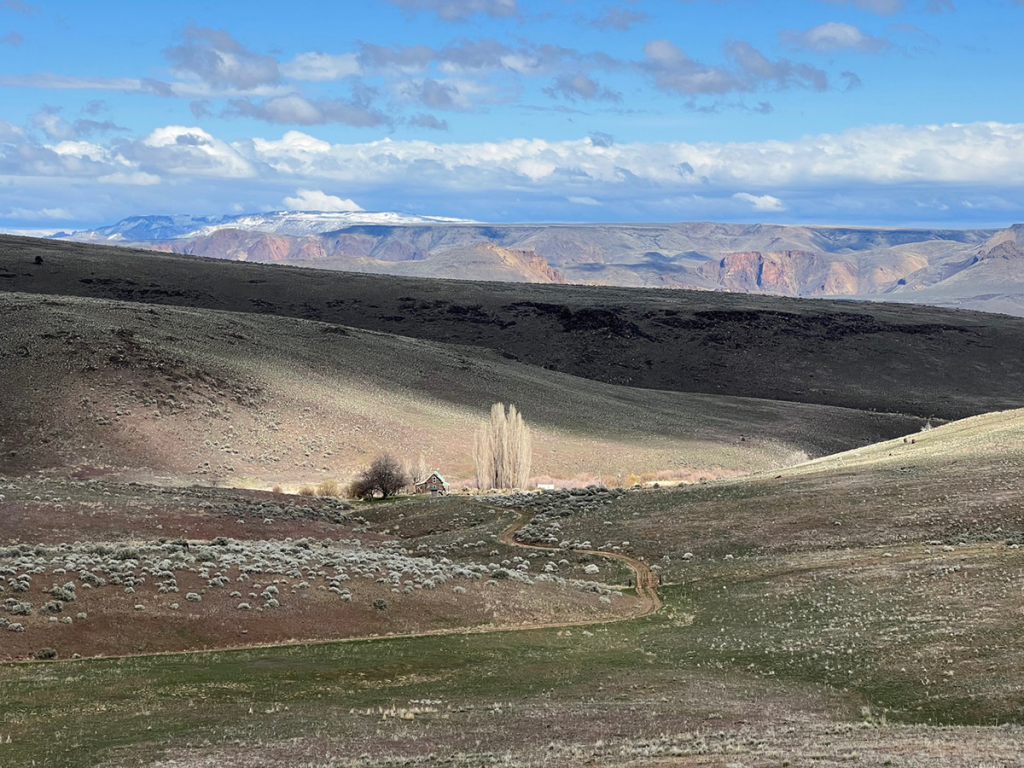
This property, with its riparian zone, springs, and 50-acre natural meadow (a lava plug resulting from lava cooling inside the vent of a once-upon-a-time volcano) is what the desert looks like when left to its own devices. As temperatures rise, causing shifts in flora and fauna, it’s just possible, if left alone, undisturbed, the desert’s ecological memory will remember what to do, will show us all how.
Now of a certain age, Sue and Stan’s dream is that this property be protected in perpetuity from all manner of trespassers: opportunistic invasive weeds, joyriding pilots landing on the meadow and scaring off wildlife, or wayward cattle feasting on the grasses and riparian zone. They seek to make this secret garden a living painting of what a thriving desert can look like. Stan jokes he has been “trying to live forever, but it’s not going to work out.” In the meantime he and Sue “are going to enjoy this special place as long as we can,” and, hopefully, in partnership with the Oregon Desert Land Trust, make it available for others to do the same for decades to come.
Photos provided by Sue and Stan Shepardson
Published May, 2026
More from the series